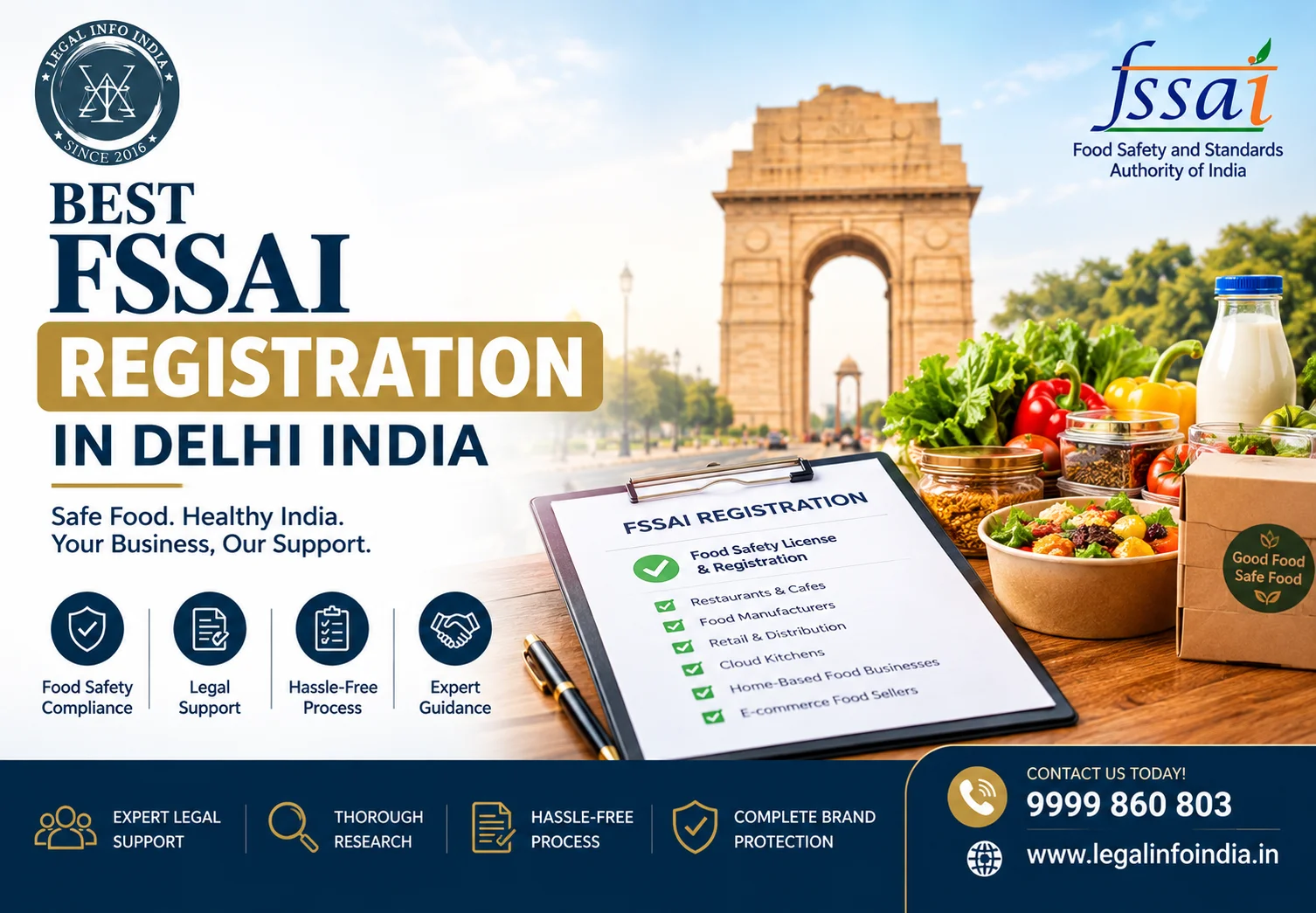

Starting a food business in Delhi can be exciting, whether you are launching a home-based food brand, cloud kitchen, restaurant, bakery, food manufacturing unit, catering business, packaged food brand, grocery business or food delivery operation.
But before focusing only on recipes, packaging, marketing and customers, there is an important legal compliance requirement that every food business operator should understand: FSSAI registration or licensing.
The Food Safety and Standards Authority of India, commonly known as FSSAI, regulates food safety and standards in India. Food businesses are required to obtain the appropriate FSSAI registration or licence according to their business activity and applicable eligibility criteria.
There has also been an important regulatory change in 2026. From 1 April 2026, FSSAI revised the turnover thresholds for categorising food businesses. Registration now generally covers businesses with annual turnover up to ₹1.5 crore, State Licence applies above ₹1.5 crore up to ₹50 crore, and Central Licence applies above ₹50 crore, subject to the specific nature of the food business and applicable eligibility criteria.
This makes understanding the current FSSAI framework particularly important for new and existing food businesses in Delhi.
In this guide, we explain what FSSAI registration means, who needs it, which category may apply to your business, documents required, fees, online application process, common mistakes and how professional assistance from Best FSSAI Registration Services in Delhi can make the process easier.
FSSAI registration is a regulatory registration for eligible food businesses under India's food safety framework. It is designed to ensure that businesses involved in activities such as manufacturing, processing, storage, distribution, transportation, retailing or selling food operate according to applicable food safety requirements.
Depending on the business category, an FBO (Food Business Operator) may require:
FSSAI Registration
FSSAI State Licence
FSSAI Central Licence
The application and licensing process is managed through the FoSCoS, Food Safety Compliance System, the official FSSAI platform. The portal provides facilities for new applications, tracking, modification and other licensing-related activities.
A major practical point is that FSSAI requirements are not determined only by turnover. The kind of business, food activity, production capacity, location and other applicable criteria can also affect the category. Therefore, simply selecting a licence based on turnover without checking the business activity can create compliance problems.
If you are researching FSSAI registration based on older articles, be careful. Many online articles still mention the earlier turnover threshold of ₹12 lakh for basic registration. However, FSSAI introduced revised turnover thresholds effective from 1 April 2026. The current broad turnover classification is:
| FSSAI Category | Current Turnover Threshold |
|---|---|
| FSSAI Registration | Up to ₹1.5 crore |
| FSSAI State Licence | Above ₹1.5 crore up to ₹50 crore |
| FSSAI Central Licence | Above ₹50 crore |
FSSAI's March 2026 order specifically states that the revised thresholds supersede the earlier thresholds and apply to new applications from 1 April 2026.
FSSAI has also introduced perpetual validity for registrations and licences under the 2026 reforms, meaning they remain valid unless suspended, cancelled or surrendered, subject to ongoing compliance requirements. This is an important change for businesses that previously planned periodic renewal based on the older framework.
However, perpetual validity does not mean that a food business can stop complying with food safety requirements. Businesses still need to maintain applicable hygiene, safety, documentation and other regulatory obligations.
If your business handles food at any stage, you should determine whether FSSAI registration or licensing is applicable. Common examples include:
Restaurants, cafes, eateries and other food service businesses may require an appropriate FSSAI registration or licence based on their activity and eligibility.
The growth of cloud kitchens has created many new food businesses in Delhi. Even if customers never visit your kitchen physically, the business still needs to address applicable food safety and licensing requirements.
Many entrepreneurs start from home by selling:
Cakes
Snacks
Pickles
Namkeen
Sweets
Homemade sauces
Bakery products
Tiffin meals
Ready-to-eat food
Packaged food
Being a home-based business does not automatically remove food safety obligations.
Businesses manufacturing or processing food products need to carefully determine the applicable FSSAI category based on their activity, products, capacity and turnover.
Businesses buying, storing and distributing food products may also fall under FSSAI requirements.
Food retailers, grocery businesses and certain direct sellers may require FSSAI registration or licensing depending on the nature and scale of operations.
Cold storage and other food storage activities are also covered by FSSAI's food business categories.
Businesses transporting food products may also require an appropriate FSSAI approval.
Food import and export activities can involve additional regulatory requirements, and the applicable FSSAI category should be checked carefully.
Businesses selling food through their own website, marketplaces, e-commerce platforms or other digital channels should not assume that operating online eliminates FSSAI compliance.
The official FoSCoS system provides different eligibility categories for businesses including importers, wholesalers, distributors, retailers, transporters, food vending agencies and other food businesses.
One of the most important steps in the application process is identifying the correct category.
Under the revised 2026 framework, businesses with turnover up to ₹1.5 crore generally fall within the registration category, subject to the applicable kind of business criteria. This may be relevant for many small food businesses such as:
Small food retailers
Home-based food businesses
Small food vendors
Small food service operators
Petty food businesses
Small traders
Certain storage and distribution businesses
The applicable category should always be verified through the current FoSCoS eligibility criteria rather than relying solely on turnover.
A State Licence generally applies where the annual turnover is above ₹1.5 crore and up to ₹50 crore, subject to the business category and applicable criteria. This may cover various medium-sized:
Restaurants
Food manufacturers
Food processors
Distributors
Storage businesses
Food service providers
Other eligible FBOs
The exact eligibility depends on the kind of business.
Central Licence generally applies to businesses with turnover above ₹50 crore and certain businesses that fall into Central Licence categories regardless of turnover. The category can also be relevant for specific activities such as certain importers, exporters and other businesses covered by Central Authority requirements. This is why an FSSAI application should be assessed according to both business activity and turnover.
Obtaining the appropriate FSSAI registration or licence is not simply about obtaining a certificate. It can become an important part of building a credible food business.
Legal Compliance — The first and most important reason is compliance with India's food safety framework. A food business should operate with the registration or licence applicable to its activities.
Consumer Confidence — Customers increasingly want to know whether a food business follows recognised safety standards. Displaying the appropriate FSSAI details can provide additional confidence to customers.
Business Credibility — A properly registered food business can present itself more professionally when dealing with customers, suppliers, distributors and commercial partners.
Online Business Expansion — Food businesses increasingly sell through websites, online marketplaces, delivery platforms, social media and e-commerce channels. Maintaining proper food compliance becomes increasingly important as the business expands.
Business Growth — A small home kitchen may eventually become a cloud kitchen, restaurant, packaged food company or retail brand. Starting with proper compliance can make future expansion easier to manage.
Better Food Safety Practices — FSSAI compliance also encourages businesses to pay attention to food handling, hygiene, storage and safety practices.
The documents depend on the type of business and the applicable FSSAI category. Common documents may include:
Applicant identity proof
PAN details where applicable
Passport-size photograph where required
Proof of business premises
Rent agreement, sale deed or electricity bill where applicable
Business constitution documents
Partnership deed, incorporation documents or proprietorship declaration, where applicable
Food product or food category details
Layout plan for applicable manufacturing or processing businesses
Details of equipment and machinery where applicable
Water analysis report where applicable to manufacturing or processing activities
Authorisation documents where applicable
Other supporting documents depending on the nature of the business
For example, the official FoSCoS document list for a State Licence includes Form B, identity and address proof, premises-related documents and additional documents applicable to manufacturers, processors, hotels, transporters and other specific businesses.
The important point is that there is no single universal document list for every FSSAI applicant. A restaurant, home baker, manufacturer, food transporter and importer may have different documentation requirements.
The application process is primarily online through FoSCoS. A simplified process is as follows.
First identify exactly what your business does. For example, "Manufacturer + Packaged Food" is different from "Restaurant + Food Service" and different from "Retailer + Food Distribution." This classification matters.
Use the FoSCoS eligibility system to determine the applicable registration or licence category. The portal provides an eligibility mechanism based on the business details entered by the applicant.
Prepare the applicable identity, address, business and food-related documents.
The applicant can initiate the application through the official FoSCoS platform.
For registration and licensing applications, the relevant application details must be provided accurately.
Upload the documents applicable to your food business.
The applicable government fee depends on the category and kind of business.
The food safety authorities may scrutinise the application and documents. Depending on the business category and regulatory requirements, inspection or additional information may be involved.
If the authority raises a query or requests clarification, the applicant should respond appropriately within the prescribed process.
After approval, the relevant registration or licence details are issued through the system. The official FoSCoS portal also provides facilities to track applications.
The government fee depends on the category and kind of business. Under the current FSSAI fee framework, the registration fee is generally ₹100 per year for applicable registration categories, while State and Central Licence fees vary depending on the business activity and applicable category. For example, the current FoSCoS eligibility tables show ₹100 for applicable registration categories, ₹5,000 for many State Licence categories and ₹7,500 for Central Licence categories, although the exact fee must be checked against the specific kind of business.
Therefore, businesses should not rely on a generic statement such as "FSSAI licence costs ₹X". The correct government fee depends on:
Kind of business
Registration or licence category
Manufacturing or processing activity
Production capacity
Turnover
Other applicable criteria
Professional service charges, if you engage a consultant, are separate from government fees.
Yes. The official FoSCoS portal provides an online system for food business registration and licensing. Applicants can use the portal for:
New registration
New licence applications
Application tracking
Modification
Other licensing-related services
The official portal also provides a dedicated eligibility checker, document resources and fee information. However, online submission does not mean that every application is automatically approved. The quality and correctness of the application remain important.
Many applications become unnecessarily complicated because of avoidable mistakes.
Choosing the Wrong Kind of Business — This is one of the most important mistakes. A food manufacturer, retailer, distributor, restaurant and repacker may have different requirements.
Using Outdated Turnover Limits — Older websites may still mention ₹12 lakh as the registration threshold. For applications from 1 April 2026, the revised broad threshold is ₹1.5 crore for registration, subject to the applicable business criteria.
Incorrect Business Address — The premises information should be entered carefully and should correspond with supporting documents.
Incorrect Food Product Details — Food categories and products should be selected accurately. This becomes particularly important for manufacturers, processors, repackers and relabellers.
Uploading Incomplete Documents — Missing or inappropriate documentation can cause clarification requests and delays.
Treating Every Food Business the Same — A home baker and a large food manufacturing unit cannot be treated as identical applicants.
Ignoring Post-Registration Compliance — Obtaining an FSSAI number is not the end of compliance. Food businesses still need to follow applicable food safety, hygiene, labelling, record keeping and other requirements.
Delhi has a growing number of entrepreneurs operating food businesses from their homes. Examples include home bakers, tiffin services, homemade snacks, pickles, sauces, sweets, cakes, ready-to-eat products and homemade packaged foods.
One common misconception is: "My business is small, so I do not need FSSAI registration." Business size alone should not be used as the deciding factor. The applicable FSSAI category should be determined based on the current eligibility rules and the actual activity being carried out.
With the 2026 revised threshold, many small businesses may fall under the registration category, but the correct category still needs to be assessed.
Cloud kitchens are another important category in Delhi. A cloud kitchen may operate without a traditional customer-facing restaurant, but it still prepares and sells food. A cloud kitchen owner should consider:
Business premises
Food preparation activity
Food categories
Turnover
Hygiene requirements
Applicable FSSAI category
Online delivery operations
Other local business permissions
The appropriate FSSAI registration or licence should be obtained before scaling the business.
FSSAI registration is a food safety compliance requirement. It does not automatically replace other registrations that may apply to your business. Depending on the business structure and activities, a food entrepreneur may also need to consider:
If operating through a company, incorporation and corporate compliance may apply. If you are starting a new food venture, you can also explore Best Company Registration in Delhi to choose an appropriate legal structure for your business.
GST registration may apply depending on the nature and scale of the business and applicable GST provisions. Food businesses should also evaluate whether they require Best GST Registration Services in Delhi based on their turnover, business model and applicable GST provisions.
Eligible businesses may consider Best MSME Registration Services in Delhi for applicable government and business benefits.
If you are building a long-term food brand, trademark registration can help protect the brand name and identity. Once your food brand name is finalised, consider Best Trademark Registration in Delhi to build stronger brand protection.
For example, a food entrepreneur launching a packaged snack brand may eventually need to consider FSSAI + GST + MSME + Trademark + business structure compliance. The exact combination depends on the business. This is why a complete legal and regulatory assessment is often more useful than obtaining one registration in isolation.
When searching online for the Best FSSAI Registration in Delhi India, businesses should look beyond price. The quality of the service depends on whether the consultant understands the business activity, chooses the appropriate category, prepares documents correctly and assists with the application process.
At Legal Info India, our approach is focused on helping entrepreneurs and businesses understand the registration requirements before proceeding with the application. We can assist businesses with areas such as:
FSSAI Registration
FSSAI State Licence
FSSAI Central Licence
FSSAI application preparation
Documentation assistance
Food business category assessment
Application submission support
Clarification and query assistance
Modification-related assistance
Food business compliance guidance
The objective is not simply to submit an online form. The objective is to help the business approach its food compliance requirements correctly from the beginning.
Imagine you are starting a home-based bakery in Delhi. You have a business name, a home kitchen, cake and bakery products, an Instagram page, online orders and plans to sell through delivery platforms. You may think the only requirement is getting an FSSAI number.
But before applying, you should determine the correct food business activity, applicable registration category, premises details, food product information and supporting documents. A similar situation arises with a cloud kitchen, packaged food manufacturer or food distributor. This is where professional assistance can reduce confusion.
Legal Info India can help you understand the process and prepare the application based on your actual business requirements.
If you are comparing different consultants, consider the following factors.
Experience With Different Food Businesses — Look for a service provider who understands restaurants, manufacturers, cloud kitchens, retailers, home businesses and other food categories.
Proper Eligibility Assessment — The consultant should not simply ask for documents and submit an application. They should first understand your business activity.
Transparent Fees — Ask for a clear distinction between government fee, professional fee and additional charges, if any.
Documentation Assistance — Proper documentation can reduce avoidable queries.
Application Support — Good support should continue beyond simply generating an application reference number.
Updated Knowledge — FSSAI regulations change. For example, the 2026 changes revised turnover thresholds and introduced perpetual validity. Therefore, using outdated information can create unnecessary confusion.
For official guidance, you may also refer to:
Food Safety and Standards Authority of India (FSSAI) — official regulator and source for current turnover thresholds and regulatory orders
FoSCoS (Food Safety Compliance System) — official portal for FSSAI registration, licensing, eligibility checking and application tracking

For a food entrepreneur in Delhi, FSSAI compliance should be considered part of the foundation of the business rather than an administrative formality.
Whether you are starting a home-based food business, cloud kitchen, restaurant, bakery, food manufacturing unit, packaged food brand, grocery business, food distribution company or online food business, understanding the correct FSSAI category is an important first step.
The 2026 regulatory changes make this even more relevant. The revised turnover thresholds now provide a broader registration category up to ₹1.5 crore, State Licence generally applies above ₹1.5 crore up to ₹50 crore, and Central Licence generally applies above ₹50 crore, subject to the specific business activity and applicable criteria. FSSAI has also moved to a perpetual validity framework, while continuing to emphasise ongoing food safety compliance.
If you are looking for Best FSSAI Registration in Delhi India, the right approach is not simply to find the cheapest application service. Choose professional assistance that understands your food business, evaluates the applicable category, helps prepare the right documents and guides you through the regulatory process.
Legal Info India can assist businesses and entrepreneurs looking for FSSAI registration and food licence support in Delhi and across India.
From 1 April 2026, the revised broad threshold for FSSAI registration is turnover up to ₹1.5 crore, while State Licence generally applies above ₹1.5 crore up to ₹50 crore and Central Licence above ₹50 crore, subject to applicable business-specific criteria.
A home-based food business may require FSSAI registration or licensing depending on its activity and applicable eligibility criteria. Being operated from home does not automatically exempt a food business from FSSAI requirements.
Yes. Applications can be made through the official FoSCoS portal, subject to the applicable process and eligibility requirements.
Documents vary according to the food business. Common documents include identity proof, premises proof, business constitution documents and food-related details. Manufacturing and processing businesses may require additional documents such as layout plans and water analysis reports.
The government registration fee for applicable registration categories is generally ₹100, while State and Central Licence fees depend on the applicable business category. Professional consultancy charges are separate.
The timeline depends on the type of application, completeness of documents, business category and whether additional scrutiny or inspection is required. It is better not to rely on a fixed number of days for every business.
FSSAI introduced perpetual validity for registrations and licences under the 2026 reforms. They remain valid unless suspended, cancelled or surrendered, while businesses must continue meeting applicable compliance requirements.
Cloud kitchens involved in preparing and selling food should determine and obtain the applicable FSSAI registration or licence based on their business activity and eligibility.
Online selling does not automatically remove food safety obligations. Businesses selling food through websites, e-commerce platforms and other online channels should determine their applicable FSSAI requirements.
Yes. Legal Info India can assist entrepreneurs and food businesses with FSSAI registration and licensing requirements, documentation, application preparation and related compliance support.

We prioritize understanding your unique situation & offer tailored strategies that align with your goals,
don't navigate the legal maze alone – schedule.

Call Us 24/7
+91 9999 860 803
Call Us 24/7
+91 8527 406 788
Mail Us Anytime
info@legalinfoindia.in
Mail Us Anytime
nrandassociate@gmail.com
© Copyright 2025 LegalInfoIndia
Developed By:Vairina Infotech



 28 Aug 2026