
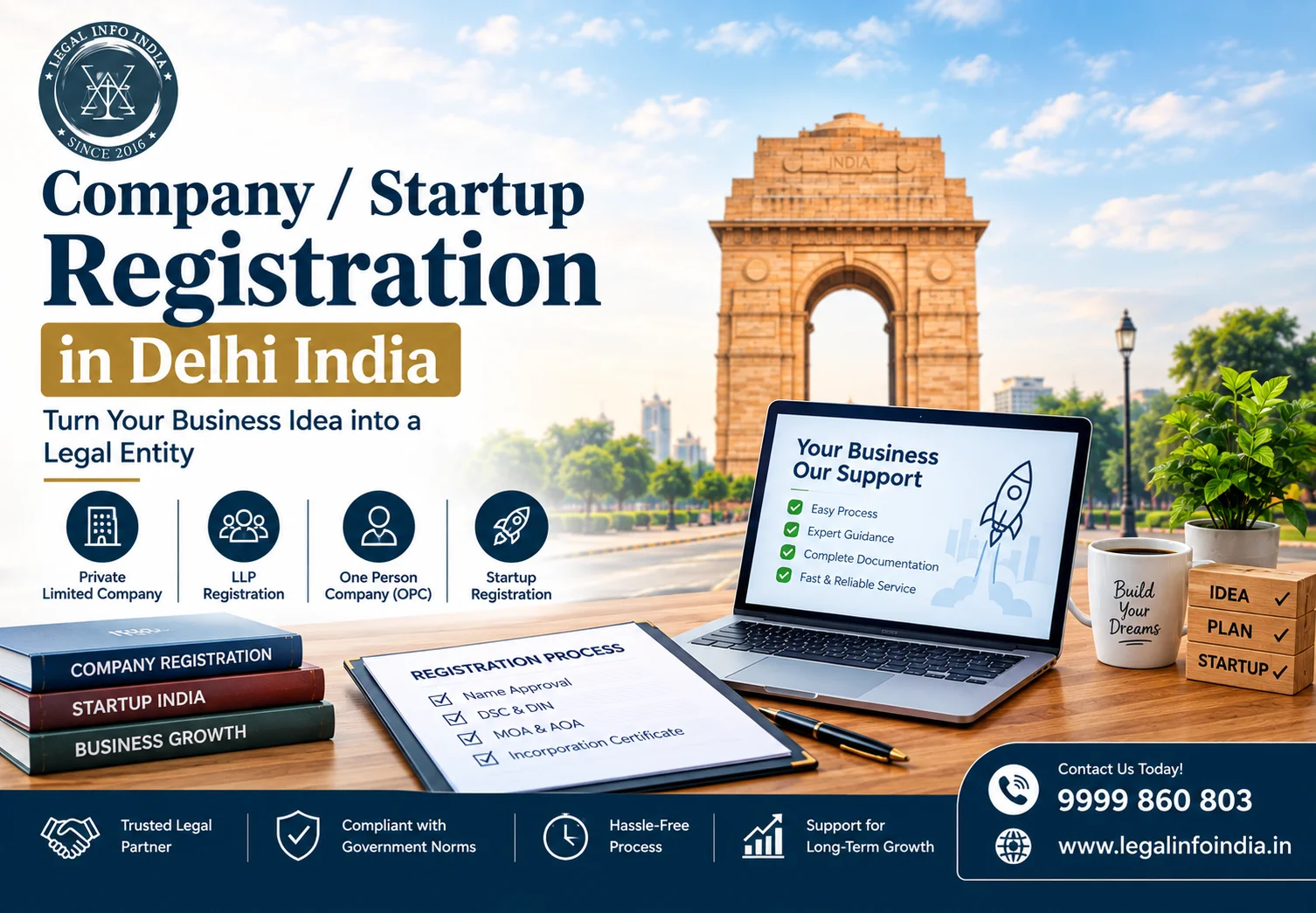

Starting a business is exciting. You have an idea, a product, a service or perhaps a business model that you believe can solve a real problem. But turning that idea into a legally recognised business requires more than just choosing a name and opening a bank account.
For entrepreneurs planning to establish a business in the capital, Company/Startup Registration in Delhi India is an important first step toward creating a formal and compliant business structure.
Delhi and the wider National Capital Region offer access to customers, skilled professionals, investors, suppliers, financial institutions and a large business ecosystem. However, choosing the correct legal structure and completing the incorporation process properly is equally important.
One important point is often misunderstood: company incorporation and Startup India recognition are not the same thing. A business generally needs to first establish an eligible legal entity and then, if it meets the applicable conditions, apply for DPIIT Startup Recognition under the Startup India framework.
This guide explains the process in simple language, including the different business structures, documents, MCA incorporation process, startup recognition, costs, timelines and important compliance considerations.
Company registration is the legal process through which a business entity is incorporated with the Ministry of Corporate Affairs (MCA) under the applicable Indian corporate laws.
Once incorporation is approved, the company receives a Certificate of Incorporation and Corporate Identification Number (CIN). The company becomes a separate legal entity from its shareholders, subject to the structure and applicable law.
For companies incorporated in India, the MCA's SPICe+ system is used for incorporation. MCA states that SPICe+ is an integrated web form for company incorporation and related services, including incorporation, DIN, PAN and TAN, with GSTIN application available where applicable.
Therefore, when someone searches for Online Company Registration in Delhi, they are generally referring to the process of preparing and submitting incorporation documentation electronically through the MCA system.
This distinction is extremely important for new entrepreneurs.
Company registration creates the legal business entity. For example, an entrepreneur may establish a Private Limited Company, One Person Company, Public Limited Company or Section 8 Company. Other business structures such as LLPs and partnership firms have separate registration processes and legal frameworks.
"Startup Registration" is commonly used to describe obtaining DPIIT Startup Recognition under the Startup India initiative. DPIIT recognition is an additional recognition process. It does not replace incorporation.
The current Startup India framework states that eligible entities can include a Private Limited Company, registered Partnership Firm, LLP or Cooperative Society, subject to the applicable eligibility requirements. The framework was revised in February 2026, including an increase in the turnover eligibility limit to ₹200 crore for regular startups and ₹300 crore for Deep Tech startups, with the age limit for Deep Tech startups increased to 20 years.
In simple terms: Business idea → Legal entity registration → PAN and other registrations → DPIIT Startup Recognition, if eligible → Other applicable registrations and compliances. This distinction can help founders avoid confusion while planning their business setup.
Delhi is home to businesses across technology, consulting, retail, professional services, ecommerce, manufacturing, food businesses, education, healthcare and many other sectors. Formal business registration can provide several practical advantages.
A company incorporated under the Companies Act has its own legal identity separate from its members, subject to applicable law. This can make it easier to enter into contracts, own assets and conduct business in the company's name.
For structures such as Private Limited Companies and LLPs, liability protection is generally available subject to the applicable law and circumstances. This can provide an important distinction between the business entity and the personal assets of its owners.
A formally registered business may provide greater confidence to customers, vendors, institutional clients and potential business partners.
Founders planning to raise external investment may prefer a structure suitable for their funding strategy. A Private Limited Company is commonly considered by startups seeking equity investment because it provides a share based ownership structure.
A registered entity can establish a current account and conduct transactions under the business's legal name, subject to bank requirements.
Eligible businesses can explore Startup India, MSME and other government programmes. However, registration alone does not automatically make a business eligible for every scheme. Each scheme has its own eligibility requirements.
One of the most important decisions before registration is selecting the appropriate structure.
A Private Limited Company is commonly considered by startups and entrepreneurs who want a scalable corporate structure. It can be suitable for technology startups, ecommerce businesses, consulting companies, digital businesses, agencies, product companies, businesses expecting investors and businesses planning to scale. A private company generally requires at least two members and two directors, subject to the Companies Act and applicable rules. MCA's SPICe+ instructions specify the relevant subscriber requirements for proposed private companies and OPCs.
An OPC can be considered by an individual entrepreneur who wants a corporate structure while operating with a single member. It can be relevant for certain solo entrepreneurs who want a company structure rather than a traditional proprietorship. However, founders should consider future growth, investment plans and compliance requirements before choosing this structure.
An LLP combines features of partnership and limited liability. It may be suitable for professional firms, consulting businesses, service businesses, businesses operated by multiple partners, and founders who do not require a conventional share based company structure. LLP incorporation follows a separate process under the LLP Act, including the MCA's FiLLiP process.
A Public Limited Company is generally considered for businesses with a different ownership and capital raising structure and has substantially different compliance requirements. It is usually not the first structure considered by a small new startup.
If the objective is to operate for charitable, social, educational, environmental or other qualifying not for profit purposes, a Section 8 Company may be relevant. The appropriate structure should be selected according to the actual purpose and proposed activities of the organisation.
The exact documents can vary depending on the entity type, directors, shareholders, registered office and whether any foreign individual or entity is involved. For a typical Indian Private Limited Company, commonly required documents include:
PAN card
Aadhaar or other accepted identity proof
Address proof
Recent photograph, where applicable
Email address
Mobile number
Digital Signature Certificate where required
Commonly required documents may include:
Ownership proof or relevant property document
Rent or lease agreement, where applicable
Recent utility bill
No Objection Certificate from the owner, where applicable
The exact documentation should be checked against the current MCA requirements for the specific incorporation application. MCA's SPICe+ documentation also makes clear that requirements can differ depending on the subscribers, directors and registered office circumstances.
The process is primarily online, but proper preparation is important.
First determine whether the proposed business should be a Private Limited Company, OPC, LLP, Public Limited Company, Section 8 Company, Partnership or another appropriate structure. Do not choose a structure simply because it is popular. Consider ownership, funding, liability, compliance and long term plans.
The proposed name should comply with MCA naming requirements. Entrepreneurs should check name availability, similar existing company names, trademark conflicts, restricted words, business activity compatibility and name rules under applicable corporate regulations.
This is also where Trademark Registration becomes relevant. A company name and a trademark are not the same thing. Registering a company name does not automatically provide comprehensive trademark protection for the brand. For a startup investing in a brand, it is therefore sensible to consider Best Trademark Registration in Delhi before finalising the business name.
Since incorporation documents are filed electronically, the relevant individuals need appropriate digital signing arrangements. DSC requirements depend on the role of the person and the forms being filed.
MCA's SPICe+ system integrates several incorporation related services. According to MCA, SPICe+ Part A deals with name reservation, while Part B covers incorporation and several linked services, including CIN, DIN, PAN and TAN, with GSTIN application available where applicable.
Two important constitutional documents for a company are the Memorandum of Association, which defines important aspects of the company's structure and objects, and the Articles of Association, which establishes rules relating to the internal management of the company. These documents should be prepared carefully because they form an important part of the incorporation process.
The required forms and linked documents are submitted electronically. The application may include details relating to the proposed company, directors, subscribers, share capital, registered office, business activities, PAN and TAN, and other applicable registrations. MCA's current incorporation process is designed as an integrated electronic process through SPICe+ and linked forms.
The application is examined by the MCA. If clarification or correction is required, the application may be sent for resubmission. This is one reason why accurate documentation and properly prepared forms are important.
After successful approval, the company is incorporated and the Certificate of Incorporation is issued. The company receives its CIN and other applicable registration details. At this point, the business has formally entered the corporate legal framework.
Company registration is not the end of the process. It is the beginning of the company's compliance journey. Depending on the business, you may need to consider:
PAN
TAN
GST Registration
MSME or Udyam Registration
FSSAI Registration
Import Export Code
Professional Tax, where applicable
Shops and Establishments related requirements
Trademark Registration
Employee related registrations
Accounting and taxation
Annual MCA filings
Income Tax Return
GST returns, where applicable
For example, an online food startup in Delhi may require company incorporation along with GST and FSSAI related compliance depending on its activities. Similarly, an ecommerce startup selling products internationally may need additional registrations such as IEC.
After establishing an eligible business entity, a startup can examine whether it qualifies for DPIIT Startup Recognition. The current Startup India framework provides eligibility requirements relating to the age of the entity, turnover, innovation or scalability and the manner in which the entity was formed.
The revised 2026 framework is particularly important because older articles may still mention the previous ₹100 crore turnover threshold. According to the current government information, the revised framework provides:
Up to 10 years for regular startups
Up to 20 years for Deep Tech startups
Turnover limit of ₹200 crore for regular startups
Turnover limit of ₹300 crore for Deep Tech startups
Innovation, development or improvement of products, processes or services, or a scalable business model with employment or wealth creation potential
The entity should not have been formed by splitting or reconstructing an existing business
Therefore, founders should check the current government requirements rather than relying on older startup registration articles.
Eligible recognised startups may be able to access certain benefits and government programmes subject to the specific eligibility requirements. These can include areas such as:
Intellectual property support
Patent related facilitation
Government procurement related relaxations
Certain compliance benefits
Access to startup schemes
Funding ecosystem support
Eligibility to apply for specified tax benefits
Importantly, DPIIT recognition does not mean that every startup automatically receives every tax exemption, grant or funding benefit. Different benefits have different conditions. Startup India itself states that applications for DPIIT recognition should be made through the designated government process and that the government does not appoint private agencies or franchises for issuing Startup India recognition.
There is no single fixed price for every company registration. The overall cost can depend on:
Type of entity
Number of directors
Authorised capital
State stamp duty
Government filing charges
DSC requirements
Professional fees
Additional registrations
Foreign director or shareholder involvement
Other specific compliance requirements
Therefore, entrepreneurs should be careful with websites advertising one universal price for every company. A professional service quotation should clearly distinguish between government fees, stamp duty, professional charges and optional registrations. This gives the entrepreneur a clearer picture of the actual cost.
The timeline depends on document readiness, name availability, accuracy of information, MCA processing, resubmission requirements, complexity of the proposed structure, and foreign director or shareholder involvement, if any. A straightforward application with properly prepared documents can generally move faster than an application requiring repeated corrections. Therefore, it is better to discuss an expected processing window rather than relying on an unconditional "guaranteed registration in X days" claim.
Choosing a Company Name Without Trademark Checking — A company name being available on MCA does not necessarily mean that the corresponding brand is free from trademark conflicts.
Choosing a Structure Only Because It Is Popular — Private Limited Company registration may be appropriate for one startup but not necessarily for every business.
Using Incorrect Address Documents — Mismatch between the registered office information and supporting documents can create problems.
Ignoring Post Incorporation Compliance — Getting a Certificate of Incorporation does not eliminate ongoing legal and tax responsibilities.
Confusing Startup Recognition With Company Incorporation — A startup cannot simply treat DPIIT recognition as a replacement for legal entity incorporation.
Assuming GST Is Automatically Required for Every New Company — GST registration depends on the applicable GST provisions and the nature and scale of the business.
Assuming Every Startup Gets Tax Benefits — DPIIT recognition and eligibility for particular tax benefits are separate considerations.
Ignoring Intellectual Property — For technology and consumer startups, brand names, logos, software, inventions and creative assets may have significant commercial value. Trademark and other IP protection should therefore be considered early.
No. These registrations serve different purposes. A company can be incorporated with the MCA and may subsequently obtain Udyam Registration if eligible as a Micro, Small or Medium Enterprise. The official Udyam portal states that Udyam Registration is free, paperless and based on self declaration. It also provides a permanent registration number and does not require renewal.
The current MSME classification is:
| Category | Investment Limit | Turnover Limit |
|---|---|---|
| Micro | Up to ₹2.5 crore | Up to ₹10 crore |
| Small | Up to ₹25 crore | Up to ₹100 crore |
| Medium | Up to ₹125 crore | Up to ₹500 crore |
These thresholds apply under the current classification framework effective from 1 April 2025. Therefore, a startup could potentially have: Private Limited Company + GST Registration + Udyam Registration + DPIIT Startup Recognition + Trademark Registration, depending on its business model and eligibility. These are not interchangeable registrations. If your business is eligible, you can learn more through our guide to Best MSME Registration Services in Delhi.
Suppose two founders want to establish a software company in Delhi. They plan to develop a SaaS product, sell subscriptions across India, raise external investment, build a unique brand, hire employees and apply for Startup India recognition. A possible compliance roadmap could be:
Choose Private Limited Company structure
Check company and trademark name availability
Obtain DSC
Prepare incorporation documents
File SPICe+ application
Receive Certificate of Incorporation
Complete applicable tax and business registrations
Apply for Udyam Registration if eligible
Apply for DPIIT Startup Recognition if eligible
Protect the startup's brand through Trademark Registration
Establish accounting and ongoing compliance systems
This approach allows the founders to think beyond incorporation and plan their business compliance as a complete ecosystem.
Starting a company involves several interconnected decisions. A mistake at the beginning can create additional work later. At Legal Info India, entrepreneurs can seek assistance with business registration and related compliance requirements according to their specific business needs. The support can include areas such as:
Company Registration
Private Limited Company Registration
LLP Registration
Business registration assistance
GST Registration
MSME Registration
FSSAI Registration
Trademark Registration
Trademark Renewal
Trademark Objection
Trademark Opposition
International Trademark Registration
Trademark Rectification
For entrepreneurs looking for Best Company Registration in Delhi, the important question should not simply be the lowest quoted price. Instead, compare the service provider on factors such as proper understanding of the proposed business, correct selection of entity structure, transparent government and professional charges, document verification, MCA filing support, communication during resubmission, post incorporation guidance, and availability of related compliance services.
Legal Info India can help entrepreneurs approach registration as part of a broader business compliance strategy rather than treating incorporation as an isolated form filling exercise. This can include ongoing brand protection needs such as Trademark Renewal Delhi, Trademark Objection Reply Delhi, and International Trademark Registration India as the business grows.
A new entrepreneur often needs more than incorporation. After company formation, the business may require GST, MSME, FSSAI, trademark protection or other registrations depending on its activities. Legal Info India provides business registration and certification related services, allowing entrepreneurs to address multiple requirements through one professional service platform.
For founders who are planning Online Company Registration in Delhi, the objective should be a legally appropriate structure, accurate documentation and a clear understanding of the compliance obligations that follow incorporation. That is where professional guidance can make the process more organised.

Starting a business in Delhi can be an exciting opportunity, but the legal foundation of the business deserves careful attention. Company/Startup Registration in Delhi India should be approached as more than simply obtaining a Certificate of Incorporation.
Entrepreneurs should first understand their business model, choose an appropriate legal structure, check the proposed name, prepare the correct documents and complete the MCA incorporation process properly.
For startups, the next stage may include DPIIT Startup Recognition, provided the entity satisfies the current eligibility requirements. The 2026 Startup India framework has also changed important eligibility thresholds, making it especially important to rely on current government information rather than outdated articles.
At the same time, founders should consider GST, Udyam, FSSAI, trademark protection, accounting, taxation and other registrations based on the actual nature of their business. The right registration structure today can make future expansion, investment, compliance and brand development more organised.
Company registration is the process of legally incorporating a business entity through the applicable government authority. Startup registration generally refers to obtaining DPIIT Startup Recognition under Startup India after establishing an eligible entity.
Yes. Company incorporation is carried out electronically through the MCA system, primarily using the SPICe+ process for new companies.
A Private Limited Company is commonly considered by startups seeking a scalable corporate structure and potential equity investment. However, LLP, OPC or another structure may be more appropriate depending on the business.
No. Company incorporation establishes the legal entity. DPIIT recognition is a separate recognition under the Startup India framework for eligible entities.
Typically, identity and address documents of directors and subscribers, registered office documents and incorporation related declarations are required. Exact requirements depend on the proposed entity and circumstances.
There is no general minimum paid up capital requirement of the kind that previously applied under older company law provisions. However, the actual capital structure should be planned according to the company's requirements.
The timeline varies depending on document readiness, name approval, MCA processing and whether resubmission is required. A professional should provide an estimated timeline rather than an unconditional guarantee.
If the business satisfies the applicable MSME criteria, it can apply for Udyam Registration. Udyam Registration is separate from company incorporation.
No. Company incorporation and trademark protection are different matters. Entrepreneurs should consider trademark searching and registration separately if brand protection is important.
Legal Info India provides assistance in areas including company registration, GST, MSME, FSSAI and trademark related services. Entrepreneurs can evaluate which registrations are applicable based on their business activities.


We prioritize understanding your unique situation & offer tailored strategies that align with your goals,
don't navigate the legal maze alone – schedule.

Call Us 24/7
+91 9999 860 803
Call Us 24/7
+91 8527 406 788
Mail Us Anytime
info@legalinfoindia.in
Mail Us Anytime
nrandassociate@gmail.com
© Copyright 2025 LegalInfoIndia
Developed By:Vairina Infotech



 08 Sep 2026