
Want to Start Selling Online? Don't Ignore These Legal Requirements.
Selling online has never been easier. Whether you want to launch a fashion brand on Amazon, sell handmade products on Meesho, start a D2C skincare business on Shopify, or create your own e-commerce website, today's digital marketplace offers tremendous opportunities.
Every day, thousands of Indian entrepreneurs are turning simple ideas into successful online businesses. Some start from their homes, some from small offices, and many begin with nothing more than a smartphone and determination.
However, while starting an online business has become simple, staying legally compliant has become more important than ever. Many entrepreneurs spend weeks selecting products, designing packaging, creating social media pages, and planning marketing campaigns. Unfortunately, they often overlook the legal requirements that protect their business and ensure smooth operations.
This oversight can result in:
Marketplace account suspension
GST notices
Trademark disputes
Customer complaints
Product listing removal
Financial penalties
Business interruptions
Loss of brand reputation
The good news is that these issues are largely preventable. By completing the right legal registrations before you start selling, you can build a strong foundation for long-term business success.
In this comprehensive guide, we'll walk you through the complete legal checklist every online seller in India should follow before selling on Amazon, Flipkart, Meesho, Instagram, WhatsApp Business, or their own website. Whether you are a startup, MSME, home-based entrepreneur, or established business, this guide will help you understand the legal requirements and avoid common mistakes.
Many first-time sellers believe that marketplaces take care of all legal responsibilities. This is a misconception. Amazon, Flipkart, and Meesho provide a platform to sell products, but the legal responsibility for your business remains yours.
As a seller, you are responsible for:
Registering your business correctly
Paying applicable taxes
Protecting your brand
Following consumer protection laws
Issuing proper invoices
Selling compliant products
Maintaining accurate records
Ignoring these responsibilities can create unnecessary legal complications as your business grows.
Let's consider an example. Rahul, a young entrepreneur from Delhi, started selling customized mobile accessories through Instagram. Within six months, his products became popular. He decided to expand to Amazon and Flipkart. Everything looked promising until he encountered several unexpected challenges.
Amazon requested GST-related information
Another seller started using a similar brand name
Customers questioned the authenticity of his products
Later, Rahul realized he had never registered his trademark or formalized his business. He had to pause his expansion and complete the legal formalities that should have been done before launching. The delay cost him valuable time, money, and customer trust. This situation is more common than many people realize.
Did You Know? Many online marketplaces have become stricter about seller verification and legal compliance. Having the proper registrations not only helps you meet platform requirements but also builds credibility with customers, suppliers, and investors.
Many entrepreneurs wonder whether selling through a marketplace is enough or whether they should also create their own website. The answer depends on your business goals. Let's compare the two approaches.
| Marketplace (Amazon, Flipkart, Meesho) | Own Website |
|---|---|
| Quick to start | Takes more setup |
| Existing customer base | You build your own audience |
| Marketplace rules apply | Greater business control |
| Platform commissions | Better profit margins |
| Limited customer data | Complete customer ownership |
| Higher competition | Stronger brand building |
Many successful businesses eventually use both approaches. They leverage marketplaces for customer acquisition while using their own website to build long-term brand loyalty. Regardless of the platform you choose, legal compliance remains essential.
Your online store is more than just a website or marketplace listing. It is a business. Like any business, it requires proper legal planning.
Think of your business as a house. Marketing, advertising, and products are the walls and interiors. Legal compliance is the foundation. Without a strong foundation, even a beautiful business can face serious challenges.
The legal foundation includes:
Business registration
Trademark protection
GST compliance
MSME registration
Product-specific licenses
Proper documentation
Consumer protection compliance
Completing these steps early saves considerable time and expense later.
Let's now understand each legal requirement in detail.
This is the first legal decision every entrepreneur should make. Your business structure affects taxation, liability, funding opportunities, and future growth. The most common business structures include:
Suitable for: Individual sellers, home-based businesses, freelancers, and beginners.
Advantages: Easy to start, low compliance, affordable setup.
Limitations: Unlimited personal liability, difficult to raise investment.
Suitable for businesses with two or more partners.
Advantages: Shared responsibilities, easy management.
Limitations: Shared liability, potential disputes among partners.
Ideal for professional firms and growing businesses.
Advantages: Limited liability, better credibility, separate legal identity.
Recommended for startups planning rapid growth.
Advantages: Strong investor confidence, limited liability, better brand image, easier fundraising, higher scalability.
| Business Type | Best For | Compliance Level | Growth Potential |
|---|---|---|---|
| Proprietorship | Small sellers | Low | Medium |
| Partnership | Family business | Medium | Medium |
| LLP | Growing businesses | Medium | High |
| Private Limited | Startups & D2C Brands | High | Very High |
Many entrepreneurs choose a business structure based only on current costs. Instead, choose one based on where you want your business to be three to five years from now. If you plan to build a national or international brand, selecting the right business structure from the beginning can save significant restructuring costs later. Legal Info India assists businesses with Best Company Registration in Delhi and Online Company Registration in Delhi, helping entrepreneurs choose the most suitable structure for long-term growth.
Did You Know? Investors, banks, and many corporate buyers often prefer dealing with legally registered business entities because they offer greater transparency and credibility.
Imagine spending lakhs of rupees on branding only to discover that someone else legally owns a similar business name. Unfortunately, this happens more often than people think.
Your brand name is one of your most valuable business assets. Whether you sell on Amazon, Flipkart, Meesho, Instagram, or your own website, customers recognize and remember your business through its brand identity. Trademark registration protects that identity.
Without trademark protection, competitors may attempt to:
Use similar brand names
Copy your logo
Mislead customers
Damage your reputation
Create marketplace disputes
For online businesses, where customers cannot physically verify products before purchase, brand trust becomes even more important. Trademark registration helps establish that trust.
A skincare startup launched successfully through Instagram and later expanded to Amazon. Sales increased steadily until another seller started using a confusingly similar brand name and packaging. Customers began leaving negative reviews on the wrong listings. The original business had to initiate legal action while also investing in customer education to restore its reputation. Early trademark registration could have significantly strengthened its legal position.
A registered trademark helps you:
Protect your brand identity
Build customer confidence
Prevent unauthorized use
Strengthen marketplace credibility
Prepare for future expansion
Increase business valuation
It also becomes easier to enforce your rights if another party attempts to misuse your brand.
Before launching your products, conduct a professional trademark availability search and file your application as early as possible. This proactive approach reduces the chances of objections and helps secure your brand from the beginning. Legal Info India provides Best Trademark Registration in Delhi, Best Online Trademark Registration in Delhi, trademark searches, objection handling, renewal, rectification, and international trademark registration support.
If there is one legal registration that almost every online seller should understand before launching their business, it is GST Registration.
Many new entrepreneurs believe GST only becomes applicable after crossing a certain turnover limit. While this may apply to some businesses, selling through e-commerce marketplaces like Amazon, Flipkart, and several other platforms often involves specific GST compliance requirements under Indian tax laws. Failing to understand these requirements can lead to delayed seller account approval, compliance notices, penalties, or interruptions in business operations.
GST registration helps your business:
Sell legally through online marketplaces
Issue GST-compliant invoices
Claim Input Tax Credit (ITC)
Build credibility with customers and suppliers
Expand operations across India
Participate in B2B sales opportunities
It also demonstrates that your business is operating within the legal framework.
GST registration is generally important if you:
Sell products through online marketplaces
Supply goods across states
Want to claim Input Tax Credit
Sell to corporate buyers
Plan to scale your business nationally
Since GST applicability depends on the nature of your business and current legal provisions, it is always advisable to seek professional guidance before starting operations.
A Delhi-based entrepreneur started selling kitchen accessories through multiple online marketplaces. Initially, orders were strong. However, incomplete GST compliance delayed marketplace verification and created issues in settlement processing. After obtaining proper GST registration and updating seller information, operations became much smoother. The entrepreneur also benefited from claiming eligible Input Tax Credit on business purchases.
Many sellers unknowingly make mistakes such as:
Delaying GST registration
Using incorrect HSN codes
Filing GST returns late
Maintaining incomplete invoices
Ignoring reconciliation with marketplace reports
Mixing personal and business expenses
These mistakes may create unnecessary compliance issues as the business grows.
GST compliance should never be treated as a one-time registration. Proper return filing, invoice management, and tax planning are equally important for a healthy business. Legal Info India provides Best GST Registration Services in Delhi and Online GST Registration India, helping entrepreneurs complete registrations smoothly while understanding their ongoing compliance responsibilities.
Did You Know? Many banks, suppliers, distributors, and institutional buyers prefer dealing with GST-registered businesses because it reflects professionalism and transparency.
Many entrepreneurs skip MSME Registration because they believe it is optional. While it may not be mandatory for every business, obtaining MSME registration can unlock several advantages that support long-term business growth. For startups and small businesses, it is one of the most valuable registrations available.
MSME (Micro, Small and Medium Enterprises) registration is a government recognition provided to eligible businesses. It helps businesses access various schemes, incentives, and financial benefits designed to encourage entrepreneurship.
Registered MSMEs may benefit from:
Easier access to business loans
Government support schemes
Better credibility
Faster participation in government tenders
Protection against delayed payments under applicable laws
Various policy benefits introduced from time to time
These benefits can significantly improve cash flow and business growth.
A small furniture manufacturer initially sold products only through local dealers. After registering as an MSME and expanding to online marketplaces, the business gained access to better financing options and participated in government procurement opportunities. The registration supported long-term expansion without requiring major additional investment.
If you are:
Selling handmade products
Manufacturing your own goods
Running a D2C brand
Operating a home-based business
Building a startup
MSME registration can strengthen your business profile and improve access to various support initiatives.
Many entrepreneurs complete company registration and GST registration but overlook MSME registration. Since the registration process is relatively straightforward, completing it early can provide long-term business advantages. Legal Info India assists businesses with Best MSME Registration Services in Delhi and MSME Registration Online India, ensuring proper documentation and guidance throughout the process.
Did You Know? Several financial institutions consider MSME registration as a positive factor while evaluating business loan applications and credit facilities.
If you plan to sell any food-related product online, obtaining the appropriate FSSAI registration or licence is an important legal requirement. Many entrepreneurs assume this applies only to restaurants. In reality, food compliance extends to a wide range of businesses.
Depending on the nature and scale of operations, FSSAI requirements may apply to businesses involved in:
Homemade food
Packaged snacks
Pickles
Bakery products
Chocolates
Health supplements
Beverages
Cloud kitchens
Grocery products
Organic food
Spices
If your product is meant for human consumption, you should evaluate whether FSSAI registration or licensing is required before selling.
It helps:
Build consumer trust
Improve marketplace acceptance
Demonstrate food safety compliance
Support business expansion
Reduce legal risks
Customers today are more conscious than ever about product authenticity and safety. Displaying proper food compliance information increases confidence in your brand.
A home baker started selling cakes through Instagram. As demand increased, the business expanded to online marketplaces. Marketplace verification required compliance-related information, including food registration details where applicable. Completing the necessary registration enabled smoother expansion and improved customer confidence.
Many food startups wait until sales increase before obtaining food compliance registrations. It is always better to understand the applicable requirements before launching products into the market. Legal Info India provides Best FSSAI Registration Services in Delhi, helping food businesses complete registrations efficiently and comply with applicable regulations.
One mistake many first-time entrepreneurs make is using their personal bank account for business transactions. Initially, this may seem convenient. However, as sales increase, it becomes difficult to separate business income from personal expenses.
A dedicated business account helps you:
Track income accurately
Maintain financial records
Simplify accounting
Manage GST compliance
Receive marketplace settlements efficiently
Build financial credibility
It also creates a more professional image when dealing with customers and suppliers.
Open a business bank account immediately after completing your business registration. Maintaining separate financial records from the beginning saves significant time during taxation, audits, and business expansion.
Good accounting is one of the foundations of a successful online business. Whether you receive ten orders a month or ten thousand, every transaction should be properly documented.
Sales invoices
Purchase invoices
GST invoices (where applicable)
Shipping expenses
Marketplace commission statements
Bank statements
Returns and refunds
Inventory purchases
Proper record keeping helps during:
GST return filing
Income tax filing
Business loan applications
Investor discussions
Financial planning
Avoid:
Missing invoices
Manual bookkeeping errors
Mixing business and personal expenses
Ignoring monthly reconciliation
Delaying accounting updates
Using reliable accounting software or professional accounting support can make compliance significantly easier.
Did You Know? Well-maintained financial records not only help with tax compliance but also make it easier to understand your business profitability, identify unnecessary expenses, and make informed growth decisions.
If you plan to sell packaged products online, legal compliance doesn't stop with GST or trademark registration. Your product packaging must also comply with applicable Legal Metrology requirements wherever they apply.
Many new sellers focus only on attractive packaging while overlooking mandatory product declarations. This mistake can lead to customer complaints, marketplace listing issues, regulatory action, or product recalls.
Legal Metrology refers to laws governing weights, measurements, and mandatory declarations on packaged commodities. Its objective is to ensure consumers receive accurate information before making a purchase. If you manufacture, pack, import, or sell packaged products, you should determine whether Legal Metrology requirements apply to your products.
Depending on the product category and applicable regulations, packaging may require information such as:
Product name
Net quantity
Maximum Retail Price (MRP)
Manufacturer or packer details
Customer care information
Date of manufacturing or packing (where applicable)
Country of origin (where applicable)
Batch or lot number
Expiry or best-before date (for applicable products)
An entrepreneur started selling herbal cosmetic products through Amazon and their own website. Although the products were of good quality, several listings were temporarily restricted because the packaging did not display complete mandatory information. After updating the packaging and ensuring regulatory compliance, the products were successfully relisted. A small packaging correction prevented future compliance issues.
Before printing thousands of product labels, have your packaging reviewed by professionals. Correcting packaging before production is significantly less expensive than redesigning products already in the market.
Did You Know? Customers are more likely to trust professionally labelled products because transparent product information reflects a responsible and reliable business.
If you're launching your own e-commerce website using Shopify, WooCommerce, Magento, or any custom platform, simply displaying products isn't enough. Every professional online store should include essential legal pages. These pages protect both your business and your customers.
This explains:
What customer information you collect
Why you collect it
How it is stored
Whether it is shared with third parties
Customer rights regarding personal information
A clear privacy policy builds customer confidence and supports compliance with applicable privacy requirements.
Your Terms and Conditions define the rules governing the use of your website. They commonly address:
Orders
Payments
Intellectual property
User responsibilities
Limitation of liability
Dispute resolution
These terms help reduce misunderstandings between businesses and customers.
Customers want clarity before making purchases. A transparent refund policy should explain:
Return eligibility
Return timelines
Refund process
Exchange policy
Non-returnable items
Clear policies also help reduce customer disputes.
Customers appreciate knowing:
Estimated delivery times
Shipping charges
Delivery locations
Order tracking
Delays and exceptions
This information improves customer experience and reduces support requests.
If cancellations are permitted, clearly explain:
When cancellation is allowed
Applicable charges
Refund timelines
Cancellation process
Many startups copy website policies from other websites. This is a risky practice. Every business has different products, processes, and legal obligations. Professionally drafted legal documents provide better protection and reflect your actual business operations.
Today's online businesses collect valuable customer information. This may include names, phone numbers, email addresses, delivery addresses, payment information, and purchase history. Customers expect businesses to handle this information responsibly. Data protection is no longer just a technical issue. It is also a legal and reputational responsibility.
Follow these practices:
Use secure payment gateways
Avoid storing unnecessary personal information
Protect customer databases
Use SSL certificates
Restrict internal access to sensitive information
Update passwords regularly
Train employees on data security
Building customer trust is just as important as generating sales.
A small online fashion store experienced unauthorized access to customer records because of weak password management. Although the issue was resolved, several customers lost confidence in the business. Simple security practices could have prevented the incident.
Legal compliance and cybersecurity go hand in hand. As your online business grows, periodically review your website policies, customer data practices, and contractual documents to ensure they remain appropriate for your operations and applicable legal requirements.
Choosing the right marketplace depends on your products, target audience, and business goals. The legal responsibilities remain similar, but operational requirements may differ. Always review the latest seller policies of each marketplace before onboarding, as requirements may change over time.
| Compliance Area | Amazon | Flipkart | Meesho |
|---|---|---|---|
| Business Registration | Recommended | Recommended | Recommended |
| GST Compliance | Generally required as applicable | Generally required as applicable | Depends on applicable requirements and seller model |
| Trademark Benefits | Excellent for brand protection | Strong brand support | Helpful for long-term growth |
| Professional Invoicing | Essential | Essential | Essential |
| Product Compliance | Required | Required | Required |
| Customer Support Standards | High | High | High |
Many successful businesses eventually use both. A balanced strategy often delivers the best long-term results.
| Marketplace | Own Website |
|---|---|
| Immediate customer reach | Full control over branding |
| Faster initial sales | Better long-term customer relationships |
| Platform marketing support | Complete ownership of customer data |
| Platform commission | Better profit margins |
| Marketplace rules | Greater operational flexibility |
| High competition | Stronger brand identity |
Many legal problems can be prevented with proper planning. Avoid these common mistakes:
Starting without a business registration
Ignoring trademark registration
Delaying GST registration where applicable
Selling food products without evaluating FSSAI requirements
Using copied logos or brand names
Publishing incomplete website policies
Maintaining poor accounting records
Ignoring packaging compliance requirements
Mixing personal and business finances
Expanding rapidly without reviewing legal compliance
Avoiding these mistakes saves significant time, money, and stress.
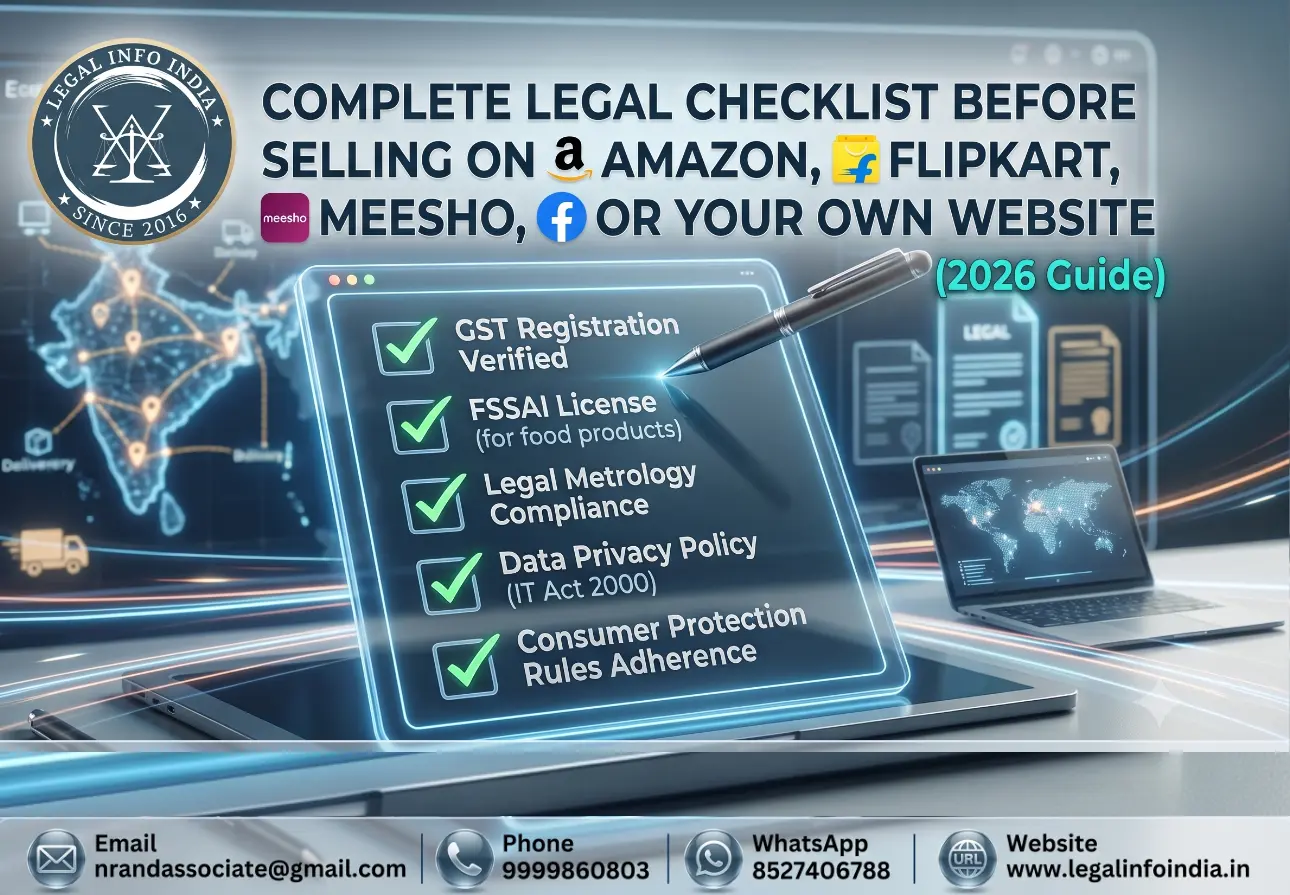
Use this checklist before your first online sale.
Choose the right business structure
Complete Company Registration (where applicable)
Register your Trademark
Obtain GST Registration if required
Apply for MSME Registration
Obtain FSSAI Registration if applicable
Open a dedicated business bank account
Prepare proper invoices
Review product packaging compliance
Create Privacy Policy
Draft Terms and Conditions
Publish Return and Refund Policy
Publish Shipping Policy
Secure your customer data
Maintain proper accounting records
Completing these steps creates a strong legal foundation for sustainable business growth.
Starting an online business involves much more than listing products on a marketplace. Every registration, licence, and legal document contributes to building a trustworthy and scalable business. At Legal Info India, we help entrepreneurs navigate this journey with confidence. Our professionals provide practical guidance tailored to your business model, whether you're launching a startup, selling through marketplaces, or building your own e-commerce brand.
Our services include:
Best Company Registration in Delhi
Online Company Registration in Delhi
Best Trademark Registration in Delhi
Best Online Trademark Registration in Delhi
Trademark Objection Reply Delhi / India
Best Trademark Renewal in Delhi
Best Trademark Rectification in Delhi
Best GST Registration Services in Delhi
Online GST Registration India
Best MSME Registration Services in Delhi
MSME Registration Online India
Best FSSAI Registration Services in Delhi
International Trademark Registration India
Experienced professionals
Transparent process
Timely assistance
End-to-end compliance support
Startup-friendly guidance
Affordable service packages
Personalized legal solutions
Our goal is to help you focus on growing your business while we help simplify the legal side of entrepreneurship.
For official guidance, you may also refer to:

Launching an online business in India has never been easier, but building a successful and sustainable brand requires much more than listing products on Amazon, Flipkart, Meesho, or your own website. Behind every successful online business is a strong legal foundation.
From selecting the right business structure to obtaining GST registration, protecting your brand through trademark registration, completing MSME registration, obtaining FSSAI registration where applicable, maintaining proper documentation, and complying with marketplace requirements, every step contributes to the long-term success of your business.
Many entrepreneurs believe legal compliance is something they can address later. In reality, businesses that complete these formalities early experience fewer disruptions, build greater customer trust, and are better prepared for future growth.
Whether you are a first-time entrepreneur, an established manufacturer, a D2C brand, or a growing startup, investing in legal compliance today can save significant time, money, and legal complications tomorrow.
At Legal Info India, we believe legal compliance should not be confusing or overwhelming. Our experienced professionals assist businesses at every stage, from business registration to trademark protection, GST registration, MSME registration, FSSAI registration, trademark renewal, trademark objection replies, trademark rectification, and international trademark registration.
If you're planning to start selling online or expand your existing business, take the first step by ensuring your legal foundation is strong. It is one of the smartest investments you can make for your business.
Yes, depending on your business model, many entrepreneurs begin as sole proprietors. However, as your business grows, choosing the right business structure becomes important for credibility, taxation, expansion, and funding. Selecting the appropriate structure should be based on your long-term business goals rather than just the initial cost.
Trademark registration is generally not mandatory to start selling, but it is highly recommended. Without trademark protection, another business may attempt to register a similar brand name, creating legal disputes and customer confusion. Registering your trademark early helps protect your brand identity and strengthens customer trust.
GST applicability depends on several factors, including the nature of your business, the products or services you sell, and the platform through which you operate. Since GST rules may change over time, it is advisable to consult a qualified professional before launching your business to determine your specific compliance requirements.
MSME registration can provide several advantages, including improved business credibility, access to government support schemes, easier financing opportunities, and certain policy benefits introduced from time to time. For startups and small businesses, it is often a valuable registration that supports long-term growth.
If your business manufactures, stores, distributes, or sells food products, you should determine whether FSSAI registration or licensing applies to your operations. This may include cloud kitchens, packaged food businesses, home bakers, snack manufacturers, grocery sellers, beverage brands, and similar food-related businesses.
Even if you are not selling through a marketplace, your business may still have legal obligations depending on the products or services offered. Proper business registration, taxation, intellectual property protection, and customer policies contribute to a more professional and legally secure business.
A registered trademark protects your brand name, logo, and identity from unauthorized use. It also improves customer confidence, supports business expansion, strengthens legal rights, and becomes a valuable business asset as your brand grows.
Yes. GST registration and trademark registration serve completely different purposes. GST relates to taxation and business compliance, while trademark registration protects your brand identity and intellectual property. Most growing businesses benefit from having both.
Yes. Legal Info India provides comprehensive business registration and compliance services, including company registration, trademark registration, GST registration, MSME registration, FSSAI registration, and international trademark registration, through a single trusted partner.
Choose your business structure, register your business if applicable, apply for trademark registration, evaluate GST requirements, obtain MSME registration, complete FSSAI registration if applicable, open a business bank account, prepare website policies, verify packaging compliance, and maintain proper accounting records.


We prioritize understanding your unique situation & offer tailored strategies that align with your goals,
don't navigate the legal maze alone – schedule.

Call Us 24/7
+91 9999 860 803
Call Us 24/7
+91 8527 406 788
Mail Us Anytime
info@legalinfoindia.in
Mail Us Anytime
nrandassociate@gmail.com
© Copyright 2025 LegalInfoIndia
Developed By:Vairina Infotech



 01 Aug 2026