
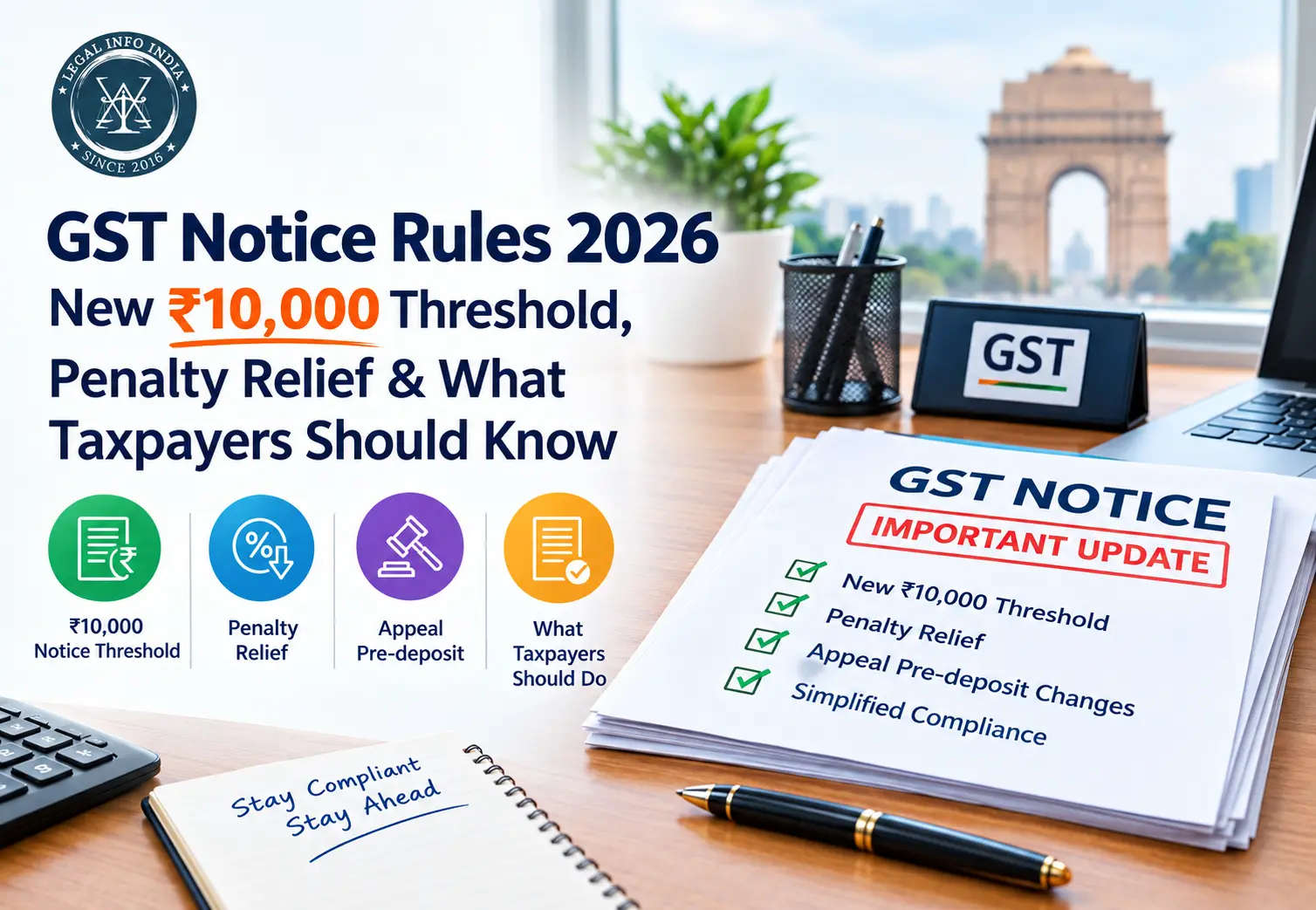

Note: This article is based on GST Council recommendations announced on 8 October 2026. The publication and last-updated dates are shown above, and the article will be revised if the CBIC, the GST Council or another competent authority issues notifications, circulars or amendments that change the legal position. It is for general information and is not a substitute for advice on an individual GST notice or dispute.
What Has Changed in GST Notice Rules in 2026?
Receiving a Goods and Services Tax (GST) notice can be stressful for a business owner. Even a relatively small tax discrepancy can lead to paperwork, professional expenses, deadlines and uncertainty about the next steps.
The latest GST Council recommendations announced on 8 October 2026 have brought welcome attention to the way GST disputes and penalties are handled. Among the important proposals is a minimum tax threshold of ₹10,000 for issuing show-cause notices under Sections 73, 74 and 74A of the Central Goods and Services Tax (CGST) Act, 2017. The Council has also recommended changes to certain penalty provisions and appeal procedures.
For small businesses, startups, online sellers and service providers, these proposals could reduce the burden of dealing with low-value tax disputes.
However, there is an important distinction that taxpayers must understand. A GST Council recommendation does not automatically become an enforceable legal rule. The relevant amendments, notifications, rules or circulars must be issued, and their effective dates must be checked before relying on a proposed benefit.
This guide explains the proposed GST Notice Rules 2026 in practical language, including the ₹10,000 threshold, penalty relief, pending notices, appeal-related changes and steps businesses should take now.
A show-cause notice is a formal communication from the tax department asking a taxpayer to explain why a proposed action should not be taken. In GST matters, this may involve unpaid tax, short payment of tax, an erroneous refund or input tax credit (ITC) that has allegedly been wrongly claimed or used.
The GST Council has recommended a minimum threshold of ₹10,000 for issuing show-cause notices under Sections 73, 74 and 74A of the CGST Act. The proposed calculation combines the relevant tax amounts under CGST, SGST or UTGST, IGST and applicable cess.
Consider these examples:
| Example | Tax amount involved | What the proposed threshold means |
|---|---|---|
| Example 1 | ₹6,000 | Below the proposed threshold |
| Example 2 | ₹9,500 | Below the proposed threshold |
| Example 3 | ₹10,000 | Threshold is met |
| Example 4 | ₹12,000 | Threshold is met |
| Example 5 | ₹4,000 CGST + ₹6,000 SGST | Combined tax is ₹10,000, so the threshold is met |
The examples illustrate the recommended threshold, not confirmation that the recommendation is already enforceable in every case.
The government's published FAQ on the recommendations clarifies that the ₹10,000 amount is calculated using the aggregate relevant tax, including applicable cess. Interest, late fees and penalties are not included when determining whether the threshold is met. It also confirms that exactly ₹10,000 meets the proposed threshold.
No. This is one of the most important points in the entire discussion.
A proposed restriction on issuing certain show-cause notices is not the same as cancelling the underlying tax liability. Businesses should not assume that they can ignore tax differences, stop maintaining records or delay correcting GST returns simply because a discrepancy is below ₹10,000.
The actual consequences will depend on the final legal wording, its commencement date, the type of proceeding and any applicable exceptions.
The proposed threshold concerns Sections 73, 74 and 74A of the CGST Act.
These provisions deal with the determination and recovery of tax in different circumstances, including cases involving alleged non-payment or short payment of tax, erroneous refunds and wrongly availed or utilised ITC.
Broadly:
Section 73: Addresses specified tax shortfalls and related issues not involving fraud, wilful misstatement or suppression of facts to evade tax, for the periods to which the provision applies.
Section 74: Deals with specified cases involving fraud, wilful misstatement or suppression of facts to evade tax.
Section 74A: Provides a framework for determining tax not paid or short paid, erroneously refunded tax and wrongly availed or utilised ITC for the relevant periods covered by that provision.
The precise provision applicable to a case depends on the relevant tax period and circumstances. A taxpayer should not assume that every GST communication falls under one of these sections.
For example, a notice relating to a return mismatch may require a different response from a communication concerning registration, an e-way bill, an audit or another compliance issue. The document's section number, issuing authority and legal basis should be checked first.
One of the most significant aspects of the GST Council recommendation is the proposed treatment of pending notices and appeals involving amounts below ₹10,000.
The Council recommended a statutory provision under which qualifying pending notices and appeals below the threshold would be dealt with as though the threshold had applied when the notice was issued.
For businesses already involved in GST proceedings, this could be relevant. However, taxpayers should not assume that an existing notice has automatically become invalid.
Before seeking relief, review the following:
The date on which the notice was issued.
The relevant tax period.
The amount of tax involved, excluding interest, late fees and penalties for threshold calculation.
Whether CGST, SGST, IGST and applicable cess need to be aggregated.
The legal provision under which the notice was issued.
Whether the relevant amendment has been notified and commenced.
Whether a reply, hearing, appeal or payment deadline is approaching.
Practical advice: Keep responding to valid communications and meeting applicable deadlines until the legal position for your case has been confirmed. Do not ignore a notice merely because the amount appears to be below ₹10,000.
The Council has recommended several changes aimed at rationalising penalties and reducing unnecessary litigation.
These proposals are particularly relevant to businesses that discover an error, face a tax demand or need to decide whether to challenge an order or settle a dispute. The proposed benefits are conditional and must be read alongside the applicable statutory provisions.
The Council recommended a reduced penalty of 5% in specified non-fraud cases where the taxpayer pays the tax and applicable interest within the prescribed period after the adjudication order.
The recommended time limits differ according to the relevant provision:
Under Section 73, payment would need to be made within 30 days of the adjudication order.
Under Section 74A, payment would need to be made within 60 days of the adjudication order.
These are proposed changes, not a general right to pay 5% in every GST dispute. The relevant section, type of case, payment conditions and final implementation provisions must be checked before acting.
The Council also recommended removing the minimum penalty of ₹10,000 in non-fraud cases covered by the proposed amendments.
This may help address situations where a fixed minimum penalty appears disproportionate to a relatively small tax discrepancy. However, the proposed change does not mean that all penalties will disappear or that every non-fraud error will be penalty-free.
Taxpayers should distinguish between the amount of tax payable, applicable interest, a statutory penalty and any separate late fee.
The Council recommended reducing the maximum general penalty under Section 125 of the CGST Act from ₹25,000 to ₹10,000.
Section 125 concerns general penalties where a contravention does not attract a separate penalty under the relevant provisions. The proposed reduction should not be interpreted as a universal cap on every GST demand, interest amount or penalty.
Where a specific section prescribes its own consequences, the position must be examined under that provision.
The Council also recommended changes concerning the treatment of penalty amounts as a "charge" in specified voluntary-payment situations.
This terminology change is not necessarily a reduction in the amount payable. The government's published FAQ explains that the substitution does not itself change the quantum of the amount due. The taxpayer would still need to pay the applicable tax, interest and prescribed amount within the relevant timeline to obtain the intended conclusion of proceedings.
The practical lesson is simple: never calculate a settlement amount based only on a headline or a social media post. Verify the relevant statutory provision and payment conditions.
A taxpayer who disagrees with a GST order may be able to challenge it through the statutory appeal mechanism, subject to the applicable conditions.
One financial barrier to an appeal can be the amount that must be deposited before the appeal is admitted or pursued. The Council recommended an upper limit of ₹40 crore for the pre-deposit in specified penalty-only cases where the order involves no demand of tax.
The proposed cap is divided between ₹20 crore under CGST and ₹20 crore under SGST or UTGST, as applicable, for the relevant appeal stages.
This recommendation is not a blanket reduction in every appeal pre-deposit. It is specifically relevant to qualifying cases involving only a penalty and no tax demand.
Before filing an appeal, taxpayers should verify:
Whether the order involves tax, interest and penalty or penalty alone.
The applicable appeal forum.
The prescribed pre-deposit percentage and any statutory maximum.
The limitation period for filing the appeal.
Whether the relevant amendment is in force.
Whether any other procedural requirement applies.
Missing an appeal deadline can have serious consequences. A business should not wait for a proposed amendment if the existing law requires action before a specific date.
Whether you operate a startup, a trading business, a manufacturing unit, a consultancy or an online store, receiving a GST notice calls for a structured response.
Identify the issuing authority, date, reference number, relevant tax period, section invoked, amount demanded and response deadline.
Check whether the document is a show-cause notice, a demand order, a discrepancy communication or another type of GST communication. These documents can have different legal consequences.
Collect and compare the relevant records, including:
GSTR-1 and GSTR-3B returns.
GSTR-2B and purchase registers, where relevant.
Sales and purchase invoices.
Credit notes and debit notes.
Electronic cash and credit ledger entries.
Payment challans.
E-way bills and other supporting records, where applicable.
The objective is to identify the actual difference and understand whether it arises from a reporting error, a timing difference, an ITC issue or a genuine tax shortfall.
A notice should not be accepted blindly. Verify the tax calculation, relevant tax period, applicable rate, credit eligibility and supporting documents.
If the demand is incorrect, prepare a fact-based response with documentary evidence. If a genuine shortfall exists, assess the applicable payment and correction options under the law.
If the notice involves less than ₹10,000 in tax, the proposed threshold may become relevant. However, you must check whether the amendment has taken effect and whether the particular proceeding falls within its scope.
Do not assume that a proposed rule automatically cancels an existing notice.
A GST notice reply should address the department's specific allegations. It should set out the relevant facts, legal grounds, calculations and supporting documents.
Avoid sending a generic reply that does not answer the issues raised. If additional time or a personal hearing is needed, consider the appropriate request under the applicable procedure.
Retain the filed response, acknowledgement, supporting documents and records of subsequent communications. These may be important if the matter proceeds to adjudication or appeal.
The proposed GST Notice Rules 2026 may offer relief in qualifying cases, but businesses should continue following sound compliance practices.
Ignoring a notice because the amount is small — A threshold recommendation is not a licence to disregard official communications.
Confusing tax with interest and penalty — The proposed ₹10,000 threshold is based on the relevant tax amount, including applicable cess. Interest, late fees and penalties are excluded from the threshold calculation according to the government's FAQ.
Assuming all penalties have been removed — The Council has recommended targeted changes. The underlying tax, applicable interest and other statutory consequences may still apply.
Missing reply or appeal deadlines — A taxpayer should not delay an urgent response while waiting for an amendment that may not yet be in force.
Relying only on news reports — News articles are useful for understanding developments, but the final notification, statutory amendment or circular is the appropriate source for determining the law applicable to a specific case.
Failing to reconcile GST returns regularly — Routine reconciliation can help identify mismatches early and reduce the likelihood of disputes.
Small businesses often operate with limited accounting resources. GST compliance can become difficult when sales grow, online marketplaces are added or several people handle invoices and returns.
A few practical controls can make a difference.
Reconcile outward supplies with the returns filed.
Review ITC claims against relevant purchase and tax records.
Keep invoices, credit notes and payment evidence organised.
Maintain a calendar for GST return filing and other applicable deadlines.
Review discrepancies before submitting returns.
Document the reasons for adjustments and corrections.
Seek professional help when a notice raises a legal interpretation or significant financial issue.
Businesses that sell through e-commerce platforms should also review their registration and reporting obligations based on their business model and the applicable GST rules.
If your business is still setting up its tax compliance, understanding the requirements for Online GST Registration India can help establish a more organised starting point. For businesses operating locally, professional guidance on Best GST Registration Services in Delhi may also be useful when registration, return filing and ongoing compliance need to be coordinated.
Businesses with several compliance requirements may also want to review our guides on Company/Startup Registration in Delhi India, Best MSME Registration in Delhi India and Best FSSAI Registration in Delhi India. You can also explore Legal Info India's GST and business registration services for further information.
As of 13 October 2026, the most responsible approach is to separate the announced recommendations from the rules that are legally in force.
The GST Council has recommended the ₹10,000 threshold, penalty rationalisation and changes to appeal pre-deposits. The Council's recommendations are to be implemented through the relevant legal instruments. Taxpayers should therefore verify the latest official notifications and commencement dates before claiming a benefit.
Here is a practical action plan:
| Situation | Recommended action |
|---|---|
| You have received a GST notice | Check the section, amount, documents and response deadline |
| The tax amount is below ₹10,000 | Track implementation of the proposed threshold and do not ignore the notice |
| A notice or appeal is already pending | Keep the case documents ready and check the final provision on pending matters |
| You have received an adjudication order | Review payment and appeal deadlines immediately |
| You believe the demand is incorrect | Prepare a documented, section-specific response |
| Your returns contain discrepancies | Reconcile records and assess the correction options currently available |
| You are unsure about penalty relief | Verify the relevant provision and seek professional advice before paying or appealing |
The official GST Council website and the Press Information Bureau should be monitored for the final documents. You can start with the GST Council website and the government's FAQ on litigation-management reforms.
A GST notice is not always proof that a business has deliberately violated the law. It may arise from a reporting difference, an ITC dispute, a calculation issue or a disagreement over the application of a legal provision.
What matters is understanding the notice, verifying the records and choosing an appropriate response.
Legal Info India helps businesses understand registration and compliance requirements and navigate relevant business documentation. Depending on the issue, taxpayers may need assistance reviewing their GST records, identifying documentation gaps, understanding applicable procedures or finding the appropriate tax professional for a disputed demand.
When evaluating any GST compliance service, consider whether the provider:
Explains the applicable rules in understandable language.
Reviews the documents relevant to your case.
Distinguishes tax, interest, penalty and late fees.
Clearly communicates deadlines and procedural risks.
Avoids promising guaranteed notice cancellation or guaranteed results.
Explains professional fees and the scope of assistance in advance.
For businesses that need registration support as well as ongoing compliance guidance, Legal Info India provides information about its services through legalinfoindia.in.
The right approach is not to rely on a headline promising complete relief. It is to understand the law that applies to your facts and take action within the required timeline.
For official guidance and the latest notifications, you may also refer to:
GST Council — for the recommendations and meeting decisions
CBIC GST Portal — for notifications, circulars and amendments
Press Information Bureau (PIB) — for the FAQ on GST litigation-management reforms, October 2026
News On AIR — for reports on the 57th GST Council meeting

The GST Notice Rules 2026 recommendations could be an important step towards reducing the burden of low-value tax disputes and making penalty procedures more proportionate. The proposed ₹10,000 threshold, reduced penalties in specified non-fraud cases and changes to penalty-only appeal pre-deposits are particularly relevant to businesses and smaller taxpayers.
However, a recommendation is not the same as an implemented legal rule. Taxpayers should continue maintaining accurate GST records, reviewing notices carefully and meeting applicable deadlines while monitoring official updates.
If you have received a GST notice, do not panic, but do not ignore it either. Understand the allegation, verify the records and take a timely, evidence-based approach.
For information on GST registration and related business compliance services, visit Legal Info India.
The GST Council has recommended a minimum tax threshold of ₹10,000 for show-cause notices under Sections 73, 74 and 74A of the CGST Act. The threshold is calculated using the relevant aggregate tax amount, including applicable cess. The recommendation must be distinguished from the final legal provision and its effective date.
Taxpayers should not assume automatic cancellation. The Council recommended a provision for handling qualifying pending notices and appeals below the threshold. The final statutory wording, commencement date and application to the specific case must be checked.
No. The government's published FAQ says that interest, late fees and penalties are not included when determining whether the proposed threshold is met. The calculation considers the relevant tax amount, including applicable cess.
According to the government's FAQ on the recommendations, exactly ₹10,000 meets the proposed minimum threshold. The restriction concerns amounts below ₹10,000, not an amount equal to the threshold.
The Council has recommended reducing the maximum general penalty under Section 125 from ₹25,000 to ₹10,000. Taxpayers should verify the relevant legal amendment and effective date before relying on the proposed reduction. It is not a universal cap on all GST liabilities and penalties.
The Council recommended a 5% penalty in specified non-fraud cases if the taxpayer pays the relevant tax and interest within the prescribed period after the adjudication order. The recommended periods are 30 days under Section 73 and 60 days under Section 74A. Eligibility depends on the final legal provisions and the circumstances of the case.
No. You should read the notice, check the legal provision and amount, collect supporting documents and respond within the applicable deadline. If the demand is incorrect, submit a reasoned reply or consider the appropriate legal remedy.
The government's FAQ states that wrongly availed or utilised ITC is included when calculating the proposed threshold. Where the relevant amount involves more than one tax head, the amounts are aggregated. The legal implementation and facts of the case must still be checked.
Check the order date, amount demanded, statutory provision and appeal deadline immediately. Do not assume that a proposed threshold or penalty change automatically removes the order. A tax professional can help assess the available payment, reply or appeal options.
Use the official GST Council website, the CBIC website and the Press Information Bureau. Look for the relevant notification, circular or statutory amendment and confirm its commencement date.


We prioritize understanding your unique situation & offer tailored strategies that align with your goals,
don't navigate the legal maze alone – schedule.

Call Us 24/7
+91 9999 860 803
Call Us 24/7
+91 8527 406 788
Mail Us Anytime
info@legalinfoindia.in
Mail Us Anytime
nrandassociate@gmail.com
© Copyright 2025 LegalInfoIndia
Developed By:Vairina Infotech



 14 Oct 2026 (Last updated: 14 Oct 2026)