

Note: This article explains the amendment announced in September 2026. The publication and last-updated dates are shown above, and the article will be revised if the DGFT issues further clarifications or notifications. It is for general information and is not a substitute for transaction-specific professional advice.
Introduction: A New Opportunity for Small Exporters in India
Starting an export business in India can open doors to customers across the world. From handmade products and textiles to jewellery, home decor, handicrafts and specialised manufactured goods, Indian entrepreneurs have many opportunities to reach international markets.
However, for a small business or first-time exporter, the initial compliance process can feel complicated. Understanding export documentation, identifying the correct authorities, arranging shipping and completing registrations may discourage entrepreneurs who want to test international demand with a few small consignments.
The Government of India has introduced an important change to address one part of this challenge.
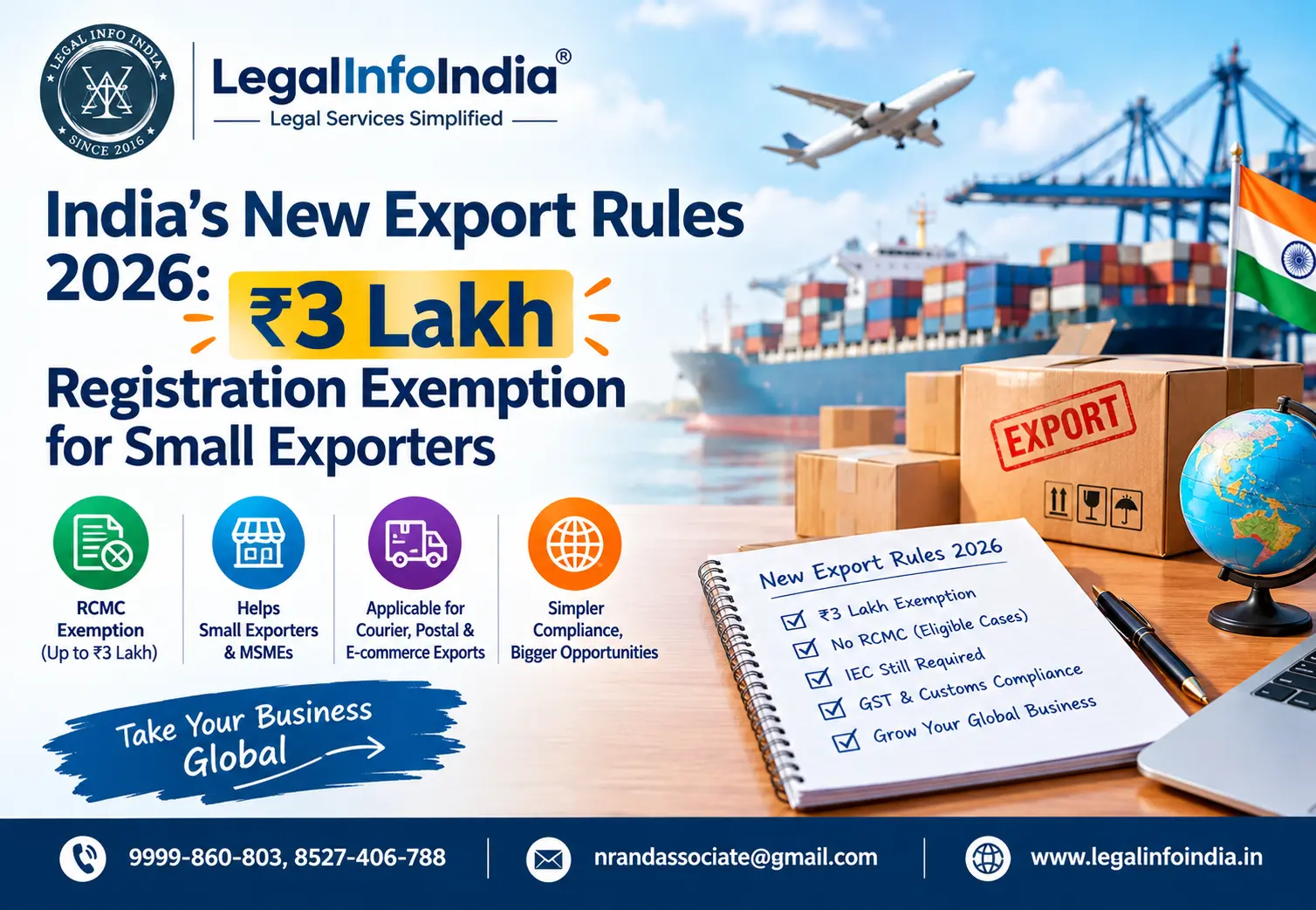
On 16 September 2026, the Ministry of Commerce and Industry announced a new exemption under the Foreign Trade Policy, 2023. Under the amendment, eligible export consignments with a Free-on-Board (FOB) value of up to ₹3 lakh do not require a Registration-cum-Membership Certificate (RCMC) or Certificate of Registration where that certificate would otherwise be required under the policy.
The change is intended to reduce the initial compliance burden for micro, small and medium enterprises (MSMEs), artisans, small businesses and first-time exporters. It is particularly relevant to low-value exports through postal services, courier networks and emerging e-commerce channels.
The amendment was notified through DGFT Notification No. 36/2026-27 dated 15 September 2026 and took effect immediately. Read the official government announcement.
But what exactly does this exemption mean? Does every exporter shipping goods worth less than ₹3 lakh qualify? Is an Importer-Exporter Code (IEC) still required? Can a small business sell internationally without GST or customs formalities?
This guide explains the new export rules in practical language so that Indian entrepreneurs can understand the opportunity and plan their export activities more confidently.
The key change is an exemption from the requirement to obtain a Registration-cum-Membership Certificate or Certificate of Registration for eligible export consignments valued at up to ₹3 lakh on an FOB basis.
Previously, exporters could need to obtain the relevant certificate from an Export Promotion Council, commodity board or another prescribed body wherever the Foreign Trade Policy required it for the relevant authorisation, benefit or concession.
For a small exporter testing a new overseas market, this additional step could mean identifying the correct registering authority, arranging documents and completing membership or registration formalities before proceeding.
The new amendment reduces that particular burden for qualifying low-value consignments.
| Particular | Position under the new rule |
|---|---|
| Effective date | 15 September 2026, with immediate effect under the notification |
| Value threshold | FOB value up to ₹3,00,000 per eligible consignment |
| Exemption | RCMC or Certificate of Registration requirement under the specified Foreign Trade Policy provisions |
| Intended beneficiaries | Small businesses, MSMEs, artisans and first-time exporters |
| Relevant channels | Postal, courier, e-commerce and other emerging export channels |
| Consignments above ₹3 lakh | RCMC or Certificate of Registration remains necessary wherever otherwise applicable |
Important: This is a limited registration exemption. It does not automatically remove other export obligations, including customs documentation, applicable GST requirements, product-specific restrictions or other registrations required by law.
The government has described the measure as a way to help small exporters enter international markets with lower initial compliance requirements. As their businesses grow, exporters can obtain membership of the relevant Export Promotion Council or commodity board where needed and access the support available through those bodies.
Official reference: Ministry of Commerce and Industry, Press Information Bureau.
RCMC stands for Registration-cum-Membership Certificate.
It is a certificate issued by the relevant Export Promotion Council, commodity board or other authorised body, depending on the product category and applicable requirements.
RCMC can be relevant when an exporter applies for certain authorisations, benefits or concessions under India's Foreign Trade Policy. The appropriate registering body may depend on the nature of the goods being exported and the applicable export promotion framework.
For example, an exporter dealing in textiles may need to identify the relevant textile export promotion body, while an exporter of agricultural products may need to check the applicable commodity-specific framework.
The exact requirement depends on the activity, product and benefit or authorisation being sought.
Imagine a small home decor manufacturer in Jaipur who receives an overseas order for handmade decorative items worth ₹1.2 lakh.
The business has products ready, a potential international buyer and a courier service available. However, the owner may not know which export promotion body is relevant or whether an RCMC is required for the intended transaction.
For an occasional exporter, these additional formalities can create uncertainty before the first shipment.
The new ₹3 lakh exemption can reduce this particular hurdle where RCMC or a Certificate of Registration would otherwise be required under the Foreign Trade Policy.
It can help eligible exporters test demand, understand shipping costs and build a record of international transactions before committing to a larger export operation.
However, the exemption should not be confused with membership of an Export Promotion Council itself. Nor does it mean that an exporter automatically qualifies for export incentives or government schemes.
The amendment is particularly relevant to businesses that want to begin exporting on a smaller scale.
Entrepreneurs who have identified an overseas buyer but have not yet established a regular export business may find the exemption useful.
It can reduce the need to complete the specific RCMC or Certificate of Registration formalities for eligible consignments, making it easier to explore whether international demand exists.
Small manufacturers, traders and service-supported product businesses often operate with limited working capital. They may prefer to begin with small orders rather than invest heavily in export infrastructure.
The exemption can lower one initial compliance burden when their consignments qualify.
Indian artisans and makers of handmade products may reach foreign customers through independent websites, online marketplaces, trade contacts or social media.
For eligible consignments, the change can make it easier to test demand for products such as handmade decor, textiles, traditional crafts and selected gift items.
Product-specific export restrictions and other legal requirements still need to be checked.
Online sellers can receive small orders from international buyers without operating a large export business.
The amendment is intended to facilitate low-value exports through e-commerce and other emerging channels, including postal and courier networks.
However, sellers should check the marketplace's documentation requirements, shipping arrangements, destination-country rules and applicable Indian compliance obligations separately.
An established Indian business may want to test whether its products appeal to customers in a new country.
A few smaller consignments can help the business evaluate pricing, packaging, shipping reliability, customer feedback and return rates before expanding.
The RCMC exemption can support this early stage where the relevant requirements are covered by the amendment.
One of the most important details is that the threshold is based on the Free-on-Board (FOB) value of an export consignment.
FOB is a trade term used to describe the value of goods at the agreed shipping point, with the allocation of costs and responsibilities determined by the applicable sale and shipping arrangement. In export documentation, the FOB value is not necessarily the same as the total amount a customer pays for an order, particularly where international freight, insurance or other charges are separately included.
For this exemption, the stated threshold is ₹3,00,000 per consignment, not a general annual turnover limit for the exporter.
| FOB value of one consignment | RCMC exemption under the new rule |
|---|---|
| ₹40,000 | Within the threshold |
| ₹1,25,000 | Within the threshold |
| ₹2,95,000 | Within the threshold |
| ₹3,00,000 | Within the threshold |
| ₹3,10,000 | Above the threshold |
These examples illustrate the value threshold only. The exemption applies where the RCMC or Certificate of Registration requirement would otherwise arise under the Foreign Trade Policy. Other applicable legal requirements remain separate.
The amendment refers to the FOB value of an export consignment. It does not describe the ₹3 lakh figure as an annual export turnover ceiling.
Consequently, an exporter should assess the FOB value of each relevant consignment and maintain proper records.
Do not assume that several orders can automatically be combined or split to qualify for an exemption. The actual shipment structure, commercial documentation and applicable rules matter.
If a consignment's FOB value exceeds ₹3 lakh, the specific exemption is unavailable for that consignment. A valid RCMC or Certificate of Registration will continue to be required wherever the Foreign Trade Policy otherwise requires it.
This does not mean every shipment above ₹3 lakh automatically requires an RCMC in every situation. The underlying requirement still depends on the applicable policy provisions and the activity involved.
No. The ₹3 lakh RCMC exemption should not be treated as a general exemption from the Importer-Exporter Code (IEC).
The IEC is a separate registration issued through the Directorate General of Foreign Trade (DGFT). It is generally required for importing or exporting goods from India, subject to applicable exemptions and specific exceptions under the prevailing rules.
The new amendment concerns the RCMC or Certificate of Registration requirement under the Foreign Trade Policy. It does not state that all exporters with consignments below ₹3 lakh can automatically export without an IEC.
Before sending goods overseas, an exporter should check whether an IEC is required for the particular transaction and whether a specific exception applies.
Other requirements may also depend on the product, export route, type of transaction and the exporter's business structure.
For official information, visit the DGFT website.
| Feature | IEC | RCMC |
|---|---|---|
| Main purpose | Identifies an importer or exporter for relevant trade activities | Provides registration or membership with the relevant export promotion body |
| Issuing authority | DGFT | Relevant Export Promotion Council, commodity board or prescribed body |
| Position under the ₹3 lakh amendment | Not generally waived by this amendment | Exempt for eligible consignments where otherwise required under the Foreign Trade Policy |
| Applicability | Subject to applicable IEC rules and exceptions | Depends on the relevant policy requirement and the consignment's FOB value |
Understanding this distinction is essential. A business should not skip a separate registration merely because a particular certificate is no longer required for an eligible shipment.
Yes, they may be. The new exemption does not automatically remove GST, customs or other statutory requirements.
Exporters should evaluate these obligations separately based on their circumstances.
The GST treatment of exports depends on the transaction and the applicable provisions of the GST law.
Exports of goods are generally treated as inter-State supplies and qualify as zero-rated supplies under the Integrated Goods and Services Tax Act, subject to the statutory framework. Eligible exporters may use the applicable route for exporting under a Letter of Undertaking (LUT) without payment of IGST or export on payment of IGST where legally permitted.
GST registration, return filing and refund eligibility should be assessed separately. The RCMC exemption does not itself create a GST registration exemption.
An exporter should verify the applicable GST registration threshold, compulsory registration provisions, export documentation and refund conditions before proceeding. If you need help with registration, read our guide to GST Registration in Delhi India.
Official resources:
Export goods generally need to comply with applicable customs procedures. Depending on the route, goods and transaction, documents may include:
Commercial invoice.
Packing list, where applicable.
Shipping bill or the relevant postal or courier export documentation.
IEC details, where required.
Product classification and export policy information.
Any applicable permits, licences or certificates.
Postal and courier exports can follow specific operational procedures. Exporters should confirm documentation requirements with their authorised courier, postal export facility, customs broker or relevant authority.
The RCMC exemption does not replace a shipping bill, customs declaration or other required export document.
Certain goods may be subject to special export conditions, quality standards, licences, certificates or restrictions.
For example, food products, agricultural commodities, chemicals, pharmaceutical products and certain regulated items may require additional checks depending on the product and destination.
An exporter must confirm whether the goods are freely exportable, restricted or prohibited under the applicable export policy and other laws.
Cross-border e-commerce gives smaller Indian businesses a way to reach customers beyond their immediate geographical market.
A seller can receive an order from a customer abroad through an online marketplace, a business website or direct communication. The product can then be packed and shipped using an eligible postal or courier channel.
For small exporters, this model can reduce the need to establish overseas offices or maintain large inventories abroad at the beginning.
The new RCMC exemption may reduce one of the compliance steps for eligible low-value consignments. Nevertheless, it does not make international shipping automatic or remove the need for correct product, customs and tax documentation.
Suppose a small Indian business sells handmade cotton bags through its own website.
An overseas buyer places an order with an FOB value of ₹85,000. The business wants to ship the order through an authorised courier.
The business should:
Confirm the exportability of the goods.
Check whether IEC and GST requirements apply.
Determine the FOB value correctly.
Check whether RCMC or a Certificate of Registration would otherwise be required.
Confirm the courier's export documentation and packaging requirements.
Retain invoices, shipment records and payment evidence.
Because the illustrative consignment is below ₹3 lakh, the RCMC exemption may apply where that certificate would otherwise be required under the Foreign Trade Policy.
The remaining checks are still important. The exemption does not guarantee that the goods can be exported without additional formalities.
A marketplace may have its own seller verification, international shipping, product listing, tax and documentation policies.
These are separate from the government's RCMC exemption. Sellers should therefore read the platform's export instructions and confirm whether the platform, courier or another authorised intermediary handles specific parts of the shipping process.
The DGFT E-Commerce Exports Handbook for MSMEs is a useful starting point for understanding the broader e-commerce export process.
The new exemption can make a first export more accessible, but proper preparation remains important.
Use the following checklist before accepting or dispatching an overseas order.
Determine exactly what you are exporting and which country will receive it.
Check the Indian export policy, destination-country import restrictions, labelling rules, product standards and any required permits.
Visit the DGFT portal and determine whether an IEC is required for your transaction. If you need one, follow the applicable registration procedure.
Do not assume the RCMC exemption removes the IEC requirement.
Identify the FOB value of the consignment and retain supporting commercial records.
If the value is close to ₹3 lakh, carefully verify the calculation and relevant trade terms before relying on the exemption.
Identify the applicable Export Promotion Council, commodity board or prescribed registration body, if relevant.
If the consignment's FOB value does not exceed ₹3 lakh, check whether the new exemption applies to the certificate requirement in your case.
Check whether GST registration, export invoices, LUT documentation, returns or other GST compliance steps apply to your business and transaction.
Where necessary, consult a qualified tax professional.
Speak to your courier, postal export facility or customs service provider about the correct procedure for your goods.
Verify invoices, product descriptions, declaration requirements, packaging and any other required documents.
Maintain copies of invoices, shipment documents, payment records, buyer communications and relevant registrations.
Good recordkeeping can help with reconciliation, refunds, customer queries and future compliance checks.
If you begin receiving larger orders, reassess your registration and compliance position before expanding.
As consignments exceed ₹3 lakh, obtain the relevant RCMC or Certificate of Registration where the Foreign Trade Policy requires it. Consider whether membership of the relevant Export Promotion Council or commodity board may also provide useful market access or export promotion support.
The impact of the amendment is not limited to saving time on a registration process. It can also reduce uncertainty at the beginning of an export journey.
Eligible exporters may be able to avoid obtaining an RCMC or Certificate of Registration upfront for qualifying consignments. This can simplify the initial process where the certificate would otherwise have been required.
A business can explore overseas demand through smaller orders before investing in a larger export operation.
Market testing helps businesses understand whether their products, pricing, packaging and shipping arrangements are suitable for international buyers.
Small manufacturers and artisans may be able to reach international customers through direct sales, e-commerce and courier channels.
The exemption can reduce one administrative barrier, although commercial success still depends on product quality, pricing, delivery and customer service.
Businesses can start with smaller transactions and develop their export processes as demand grows.
As the business scales, it can assess the registrations, memberships, product approvals and operational systems needed for larger and more regular shipments.
For some small businesses, the first export order is an important step toward developing a new revenue stream. Reducing a specific compliance requirement can make that first step easier, provided the exporter meets all other applicable conditions.
Even when a registration exemption applies, exporters can run into problems if they interpret it too broadly.
Assuming all export registration requirements have been removed. The amendment concerns the RCMC or Certificate of Registration requirement specified under the Foreign Trade Policy. It does not remove all registrations, licences or declarations.
Confusing IEC with RCMC. These are different requirements. Check whether an IEC is required independently of the RCMC exemption.
Treating ₹3 lakh as an annual turnover limit. The amendment refers to the FOB value of an export consignment. Do not treat it as a universal annual export turnover ceiling.
Calculating the value without checking FOB terms. The invoiced total may include freight, insurance or other charges. Confirm the appropriate FOB value using the applicable trade terms and documentation.
Ignoring product restrictions. The value of a shipment does not make a restricted or prohibited product freely exportable. Check the export policy and all relevant product-specific rules.
Assuming GST compliance is no longer necessary. GST registration, invoicing, returns and refund rules operate independently of the RCMC exemption.
Ignoring the destination country's rules. The importing country may impose customs duties, product standards, labelling requirements, permits or other conditions.
Waiting until the shipment is ready to check compliance. Check the applicable rules before accepting an order or promising a delivery date. Early preparation helps avoid last-minute delays.
For entrepreneurs entering international trade, understanding the difference between a registration exemption and a complete exemption from compliance is essential.
Legal Info India supports businesses with registration-related and business compliance services. Depending on your requirements, our team can help you understand relevant business registration options and identify the documentation and compliance questions that should be reviewed before starting or expanding a business.
Our services include:
Guidance on business documentation and registration requirements.
Trademark registration and brand protection support for businesses preparing to reach new markets.
If you are starting an import-export business, you may also find our related guide useful: How to Start an Import-Export Business in India: Legal Checklist for 2026.
For business registration assistance, visit Legal Info India or explore our services.
Export compliance can involve several different authorities and legal frameworks. Where your case requires specialist customs, foreign trade, GST or product-specific advice, consult the relevant authority or a suitably qualified professional.
Government of India, Press Information Bureau: Government Eases RCMC Requirement for Export Consignments up to ₹3 Lakh
Directorate General of Foreign Trade: DGFT Official Website
DGFT E-Commerce Exports Handbook for MSMEs: available through the DGFT website
GST Portal: Official GST services and information
CBIC GST: GST laws and guidance

India's new ₹3 lakh RCMC exemption is a practical step toward making small-value exports easier to begin. By removing a specific registration requirement for eligible consignments, the amendment can help first-time exporters, artisans, MSMEs and online sellers explore international markets with a lower initial compliance burden.
The most important point is to understand what the exemption actually covers. It is not a blanket waiver of IEC, GST, customs documentation, product licences or other applicable export requirements. The ₹3 lakh threshold is based on the FOB value of an individual consignment, and RCMC or Certificate of Registration requirements remain applicable above that threshold wherever the Foreign Trade Policy otherwise requires them.
For a small business considering international sales, the sensible approach is to check the product rules, identify the relevant registrations, calculate the FOB value correctly and confirm shipping documentation before dispatch.
With proper planning, the new rule may help eligible businesses take their first steps toward international trade and build a stronger foundation for future export growth.
Need help with business registration or compliance preparation? Visit Legal Info India to explore our business registration and compliance-related services.
The amendment exempts export consignments with an FOB value of up to ₹3 lakh from the requirement to obtain an RCMC or Certificate of Registration where that certificate would otherwise be required under the Foreign Trade Policy, 2023. It was introduced through DGFT Notification No. 36/2026-27 dated 15 September 2026.
The DGFT notification is dated 15 September 2026 and states that the amendment takes effect immediately. The government announced the measure publicly on 16 September 2026.
No. The amendment concerns RCMC or Certificate of Registration requirements. An IEC may still be required under the applicable rules, subject to specific exceptions.
No. The amendment refers to the FOB value of an export consignment. It should not be interpreted as a general annual export turnover limit.
The government has specifically identified postal, courier and emerging export channels as intended beneficiaries. However, all other requirements applicable to the goods, shipment and transaction must still be checked.
The RCMC exemption does not decide whether GST registration is required. GST registration and compliance depend on the applicable GST provisions and the circumstances of the business. Check the rules before exporting.
The specific ₹3 lakh exemption does not cover a consignment with an FOB value of ₹3.5 lakh. An RCMC or Certificate of Registration will continue to be required if it is otherwise applicable under the Foreign Trade Policy.
Potentially, yes. Artisans and small businesses are among the intended beneficiaries if their consignments meet the threshold and the relevant certificate would otherwise be required. They must still comply with other applicable export requirements.
The amendment concerns a certificate requirement under the Foreign Trade Policy. It does not override product-specific export restrictions, prohibitions, licences or other applicable laws. Check the export policy for the specific product.
If your consignments exceed ₹3 lakh, the exemption no longer applies to those consignments. You should obtain the relevant RCMC or Certificate of Registration wherever required under the Foreign Trade Policy. Membership may also be useful for accessing export promotion and market support services.


We prioritize understanding your unique situation & offer tailored strategies that align with your goals,
don't navigate the legal maze alone – schedule.

Call Us 24/7
+91 9999 860 803
Call Us 24/7
+91 8527 406 788
Mail Us Anytime
info@legalinfoindia.in
Mail Us Anytime
nrandassociate@gmail.com
© Copyright 2025 LegalInfoIndia
Developed By:Vairina Infotech



 01 Oct 2026