
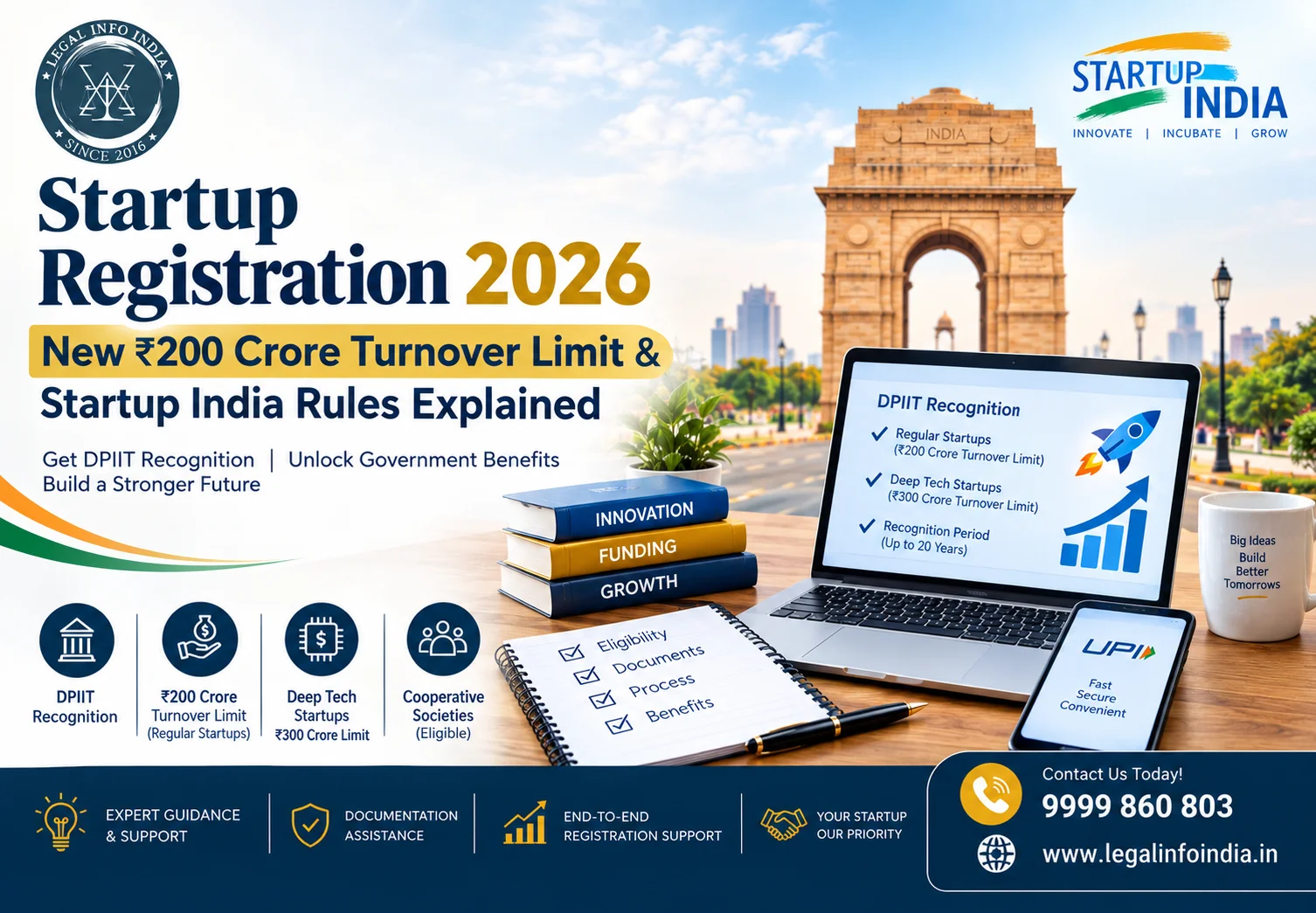

India's startup ecosystem has changed significantly since the launch of the Startup India initiative in 2016. In 2026, one of the most important changes for entrepreneurs is the revised definition of a startup under DPIIT Gazette Notification G.S.R. 108(E), dated 4 February 2026.
The headline change is straightforward: the turnover ceiling for a regular startup has increased from ₹100 crore to ₹200 crore.
At the same time, the 2026 framework introduces a separate Deep Tech Startup category, with a recognition period of up to 20 years and a turnover ceiling of ₹300 crore, subject to the applicable conditions. The revised framework also expands the eligible entity types to include cooperative societies.
These changes matter to founders who are considering Startup Registration in Delhi India, existing DPIIT-recognised startups approaching the previous turnover ceiling, and businesses in technology-intensive sectors.
However, one important distinction should be understood from the beginning: incorporating a company is not the same thing as obtaining DPIIT startup recognition. A founder may first need to establish a suitable legal entity, such as a Private Limited Company or LLP, and then separately apply for recognition under the Startup India framework if the business satisfies the prescribed conditions.
This guide explains the new Startup India rules for 2026, the ₹200 crore turnover limit, Deep Tech provisions, eligibility, documents, benefits, registration process and important points for entrepreneurs in Delhi and across India.
The term "startup registration" is commonly used to describe the process of getting a business established and, where eligible, obtaining DPIIT recognition under the Startup India initiative. There are therefore two different stages that entrepreneurs should distinguish.
Depending on the business structure, an entrepreneur may establish the business as:
Private Limited Company
Limited Liability Partnership
Registered Partnership Firm
Eligible Cooperative Society
After establishing an eligible entity, the business can apply for recognition under the Startup India initiative if it meets the applicable startup criteria. The current Startup India portal states that eligible entities can apply for DPIIT recognition through the National Single Window System.
Therefore, when someone searches for Startup Registration in Delhi India, they may actually be looking for either company incorporation, DPIIT recognition, or both. Understanding the difference can prevent unnecessary confusion.
The major changes come from G.S.R. 108(E), issued by DPIIT on 4 February 2026. The notification superseded the earlier 2019 startup framework. Here is the broad comparison:
| Criteria | Earlier Framework | 2026 Framework |
|---|---|---|
| Regular startup turnover ceiling | ₹100 crore | ₹200 crore |
| Regular recognition period | 10 years | 10 years |
| Deep Tech category | Not separately structured | Introduced |
| Deep Tech turnover ceiling | Not applicable | ₹300 crore |
| Deep Tech recognition period | Not applicable | 20 years |
| Cooperative societies | Not generally included in earlier framework | Eligible subject to conditions |
The Startup India portal now reflects the revised ₹200 crore threshold for regular startups and ₹300 crore threshold for recognised Deep Tech startups.
The most widely discussed change is the increase in the turnover ceiling. Under the 2026 framework, a regular startup must have turnover not exceeding ₹200 crore in any financial year since incorporation or registration, subject to the conditions of the notification. This is important because the previous framework used a ₹100 crore ceiling.
Suppose a technology company was incorporated in 2020. Its turnover was: 2021 — ₹8 crore; 2022 — ₹25 crore; 2023 — ₹65 crore; 2024 — ₹120 crore; 2025 — ₹175 crore. The company has not crossed the ₹200 crore ceiling. However, if its turnover in a relevant financial year exceeds the applicable ₹200 crore threshold, it can cease to qualify as a startup under the recognition framework.
The Startup India recognition form specifically states that a non-DeepTech startup ceases to be a startup after 10 years or when turnover exceeds ₹200 crore in a financial year, while the corresponding Deep Tech thresholds are 20 years and ₹300 crore.
No. The ₹200 crore threshold applies to the regular startup category under the revised DPIIT recognition framework. The 2026 rules also create a separate Deep Tech Startup category. For eligible Deep Tech startups, the recognition period can extend up to 20 years and the turnover ceiling is ₹300 crore.
The Deep Tech category has additional requirements relating to the nature and technological characteristics of the business. The Startup India recognition application includes specific questions and supporting-document requirements for applicants seeking recognition under the Deep Tech category. Therefore, founders should not assume that simply describing a business as "technology-based" automatically makes it a Deep Tech Startup.
Deep Tech is particularly relevant to businesses working with sophisticated technologies and substantial research and development. The 2026 Startup India recognition process contains a dedicated Deep Tech section. Applicants may be asked to provide information and evidence concerning areas such as:
Novel systems or processes
Research and development
Core technology
Technology indispensability
Alignment with national missions
Supporting technical documentation
Intellectual property and technological development
The current recognition form includes dedicated questions and document-upload fields for Deep Tech applicants. A conventional online marketplace, consulting company or ordinary service business should not automatically assume that it qualifies for the Deep Tech category simply because it uses software. The actual nature of the technology and the applicable recognition criteria need to be examined.
Under the current framework, eligible entities can include:
Private Limited Companies
Registered Partnership Firms
Limited Liability Partnerships
Cooperative Societies meeting the applicable requirements
The Startup India portal currently lists these entity forms under its startup recognition criteria. The entity must also satisfy requirements relating to age of the business, turnover, innovation, development or improvement, or scalability, originality of the business, and other conditions under the applicable notification.
For a regular startup, the entity can generally be recognised for up to 10 years from incorporation or registration. For an eligible Deep Tech Startup, the recognition period can extend to 20 years from incorporation or registration. The Startup India portal expressly reflects these periods in its current eligibility criteria. This does not mean that every company automatically remains a "startup" for 10 or 20 years. The business must continue to satisfy the applicable requirements.
Being newly incorporated is not enough. The startup should be working towards innovation, development or improvement of products, development or improvement of services, or development or improvement of processes. Alternatively, the business may have a scalable business model with significant potential for employment generation or wealth creation, subject to the applicable rules.
This is one of the most important aspects of Startup Registration 2026. A newly incorporated business is not automatically a DPIIT-recognised startup merely because it is young.
The framework can be relevant to startups operating across many sectors. Examples include:
SaaS platforms
Artificial intelligence businesses
Software products
Cybersecurity companies
Fintech platforms
D2C brands
New consumer products
Innovative retail platforms
Marketplace businesses
Where the business model involves qualifying innovation or scalability, certain service businesses may also be relevant.
Deep Tech startups can be particularly relevant where the business satisfies the additional requirements under the Deep Tech recognition framework. The important point is that industry name alone does not establish eligibility. The business model and its compliance with the applicable criteria matter.
This is one of the most common questions entrepreneurs ask.
| Company Registration | DPIIT Startup Recognition |
|---|---|
| Creates/registers the legal business entity | Recognises an eligible entity under Startup India |
| May be handled through MCA or applicable registration authority | Startup recognition is under DPIIT |
| Gives the entity its legal structure | Provides access to Startup India recognition-related benefits |
| Required before recognition for many entity structures | Available only if prescribed startup criteria are met |
| Does not automatically make the company a DPIIT startup | Requires a separate recognition application |
For example, an entrepreneur may complete Online Company Registration in Delhi for a Private Limited Company. That company can then evaluate whether it qualifies for DPIIT recognition. So: Company incorporation ≠ DPIIT Startup Recognition. This distinction should be clear before applying.
The current Startup India portal states that startup recognition applications are made through the National Single Window System (NSWS). A simplified process is as follows.
Choose the appropriate structure, such as a Private Limited Company, LLP, Registered Partnership, or Eligible Cooperative Society.
You should have accurate information about entity name, incorporation or registration date, PAN, CIN/LLPIN or applicable registration details, business activities, website (if available) and founders and authorised representative.
The application asks the startup to explain the problem it is solving, its proposed solution, uniqueness and revenue model. The current recognition form includes specific fields covering innovation, scalability, employment or wealth creation and the startup's activities.
The application may require documents such as the incorporation or registration certificate and supporting material explaining the startup's innovation or scalability.
The application is submitted through the applicable Startup India/NSWS process.
Once approved, the startup can obtain its recognition certificate. Startup India also provides a mechanism for verifying or downloading recognition certificates.
The exact documents can vary depending on the entity and circumstances. Commonly relevant documents and information include:
Certificate of Incorporation or registration
PAN
CIN or LLPIN, where applicable
Partnership or LLP documents, where relevant
Authorisation letter
Business website or supporting link
Pitch deck
Product or service information
Proof supporting innovation
Patent or other IPR information, if applicable
Funding information, where applicable
Awards or recognition documents, if applicable
Technical documents for Deep Tech applications
The current recognition form specifically asks applicants to upload the incorporation or registration certificate and supporting information. It also provides additional fields for documents such as websites, videos, pitch decks, patents and other evidence.
Startup India's FAQ states that recognition is typically issued within 2 working days after successful submission, although actual processing can depend on the application and any requirements for clarification or supporting information. Therefore, entrepreneurs should not treat two working days as an unconditional guarantee. A complete and accurate application can help avoid unnecessary delays caused by missing or inconsistent information.
Yes. The Startup India portal states that the Ministry of Commerce and Industry does not charge a fee for DPIIT Certificate of Recognition or Certificate of Eligibility applications. It also states that DPIIT has not appointed agencies, representatives or franchises for issuing these certificates.
This is important because entrepreneurs sometimes encounter third parties offering "government startup registration" for a fee. A professional consultant may charge a separate service fee for assistance, documentation or advisory work, but that should not be confused with a government fee for DPIIT recognition.
Recognition under Startup India can provide access to various benefits and support mechanisms, subject to their individual eligibility conditions. The Startup India portal identifies benefits including:
Self-certification
Intellectual property support
Patent and IPR facilitation
Income tax exemption eligibility
Easier public procurement norms
Easier winding up
Access to Startup India ecosystem support
However, DPIIT recognition should not be interpreted as an automatic grant of every Startup India benefit. Many benefits have separate eligibility requirements and application procedures.
No. This is an important distinction. The Startup India portal explains that a recognised startup may separately apply for income tax exemption under Section 80-IAC, subject to the applicable requirements. The portal states that eligible recognised startups may obtain a tax holiday for three consecutive financial years out of the first ten years after incorporation, after obtaining the required approval.
The current portal also states that Section 80-IAC eligibility is limited to Private Limited Companies and LLPs satisfying the relevant conditions. Therefore: DPIIT Recognition ≠ Automatic Tax Exemption. The two should be treated as separate compliance steps.
Startup India provides various forms of support relating to intellectual property. The Startup India initiative lists patent application and IPR protection among the benefits associated with DPIIT recognition. For a technology or product startup, protecting intellectual property can be important because the value of the business may depend substantially on brand name, trademark, software-related assets, designs, patents, proprietary technology, and copyright-protected material.
This is why startup founders should consider IP protection alongside incorporation and DPIIT recognition. For example, a startup may complete company registration but delay trademark protection. If the business intends to build a long-term brand, Best Trademark Registration in Delhi should be considered separately, and for cross-border expansion, International Trademark Registration India should also be evaluated.
Startup India provides procurement-related benefits for recognised startups. The Startup India scheme describes opportunities through the Government e-Marketplace and exemptions from certain prior experience, turnover and earnest money deposit requirements, subject to the applicable procurement conditions. This can be particularly relevant to startups developing products or services for government departments. However, procurement exemptions do not mean that a startup automatically wins a government tender. The startup still needs to satisfy the technical, quality, eligibility and tender-specific conditions.
Delhi has a large ecosystem of technology companies, consultants, professional firms, ecommerce businesses and early-stage ventures. Entrepreneurs planning Startup Registration in Delhi India should consider the process in stages.
Consider whether the venture should operate as a Private Limited Company, LLP, Partnership, or Eligible Cooperative Society.
Obtain the appropriate registration and statutory identifiers.
Check business age, turnover, business model, innovation, scalability, entity structure and other applicable conditions.
Create a clear explanation of: Problem → Solution → Innovation → Scalability → Revenue Model.
Depending on the business, this may include GST Registration, MSME/Udyam Registration, Trademark Registration, FSSAI registration or licence, Import Export Code, and other sector-specific approvals. These registrations serve different legal and commercial purposes and should not be treated as interchangeable with DPIIT recognition.
Assuming Incorporation Automatically Creates Startup Status — A newly incorporated company does not automatically become a DPIIT-recognised startup.
Using the Old ₹100 Crore Figure — The current regular startup turnover ceiling is ₹200 crore under the 2026 framework.
Assuming Every Technology Company Is Deep Tech — Deep Tech recognition involves additional criteria and supporting information.
Treating DPIIT Recognition as a Tax Exemption — Tax benefits such as Section 80-IAC involve separate conditions and processes.
Providing Vague Innovation Information — The recognition application asks the startup to explain its problem, solution, uniqueness and revenue model. A generic description may not adequately communicate the business model.
Ignoring Trademark Protection — Registering a company name does not provide the same protection as registering a trademark.
Assuming Government Benefits Are Automatic — Different Startup India benefits can have separate eligibility requirements.
Founders often compare DPIIT recognition with MSME/Udyam Registration. They are different.
| Feature | DPIIT Startup Recognition | Udyam Registration |
|---|---|---|
| Main purpose | Startup recognition | MSME classification/registration |
| Authority | DPIIT / Startup India | Ministry of MSME |
| Innovation requirement | Relevant to startup criteria | Not the same startup innovation test |
| Turnover criteria | ₹200 crore regular startup threshold under 2026 framework | Different MSME classification criteria |
| Deep Tech category | Yes | No equivalent category |
| Tax benefits | Certain benefits may require separate eligibility | Different scheme-based benefits |
| Can both apply? | Yes, where eligible | Yes, where eligible |
A startup should evaluate each registration independently rather than assuming one replaces the other. If your business is eligible, you can learn more through our guide to Best MSME Registration in Delhi.
Another common search is Best Company Registration in Delhi. Company registration and DPIIT recognition answer two different questions. Company registration asks: "How should my business be legally incorporated?" DPIIT recognition asks: "Does my existing eligible entity satisfy the Startup India recognition framework?"
For many founders, both may form part of the broader business setup process. A startup founder could therefore require assistance with incorporation first and DPIIT recognition afterwards.
For an entrepreneur starting a business in Delhi, the paperwork can be only one part of the challenge. The more important task is understanding which registrations are actually relevant. Legal Info India can assist entrepreneurs in navigating business registration and related compliance requirements, including:
Startup-related registration support
Trademark Opposition
Trademark Rectification
For a new venture, these services can form part of a broader legal and compliance roadmap. For example, a founder launching an online consumer brand may need to think beyond company incorporation and consider GST, MSME, trademark protection and other business-specific registrations. The right combination depends on the nature and stage of the business.
Imagine three founders in Delhi launch a SaaS platform in April 2026. They establish a Private Limited Company and begin developing their software platform. During the first few years, the company generates: Year 1 — ₹2 crore; Year 2 — ₹12 crore; Year 3 — ₹40 crore; Year 4 — ₹90 crore.
The founders may evaluate DPIIT recognition if the company meets the applicable startup conditions. If the business continues to grow, the revised ₹200 crore threshold provides substantially more turnover headroom than the previous ₹100 crore framework. If the company believes it qualifies for the Deep Tech category, it would need to evaluate the additional Deep Tech requirements rather than assuming the category applies automatically.
Businesses that already have DPIIT recognition should not ignore the 2026 changes. The Startup India portal specifically advises DPIIT-recognised startups to log in using their registered credentials and download their updated recognition certificate following the revised framework.
Existing recognised startups should therefore consider reviewing:
Updated recognition certificate
Entity information
Turnover position
Recognition period
Deep Tech eligibility, if relevant
Tax benefit eligibility
IPR status
Other Startup India benefits being used
Keeping these records updated can help maintain accurate compliance documentation.
For official guidance, you may also refer to:
Startup India Official Portal — for DPIIT recognition, eligibility criteria and scheme benefits
DPIIT (Department for Promotion of Industry and Internal Trade) — for the official G.S.R. 108(E) notification and related policy updates

The Startup Registration 2026 landscape has changed significantly with the revised DPIIT framework. The most important points for entrepreneurs are:
The regular startup turnover ceiling is now ₹200 crore. The regular recognition period remains 10 years. A separate Deep Tech Startup category provides up to 20 years of recognition and a ₹300 crore turnover ceiling, subject to the applicable criteria. Cooperative societies are now included among eligible entity forms under the revised framework.
Company incorporation and DPIIT Startup Recognition are separate processes. DPIIT recognition does not automatically provide every tax or government benefit. Tax exemptions such as Section 80-IAC have separate eligibility requirements. The DPIIT recognition application is made through the Startup India/NSWS process, and it does not carry a government application fee. Existing recognised startups should review their updated recognition certificate and current eligibility position.
For founders planning a new venture in Delhi, the best approach is to look at startup registration as part of a wider compliance roadmap rather than treating it as a single certificate. Your business structure, GST requirements, MSME status, intellectual property protection, sector-specific licences and DPIIT recognition can each serve a different purpose.
Legal Info India can help entrepreneurs understand these registration requirements and organise the appropriate business compliance steps based on the nature and stage of their venture.
For a regular startup under the revised DPIIT framework, the turnover ceiling is ₹200 crore in any financial year since incorporation or registration, subject to the applicable conditions.
The revised framework provides a turnover ceiling of ₹300 crore for a recognised Deep Tech Startup, along with a recognition period of up to 20 years, subject to the applicable criteria.
No. Company incorporation establishes the legal business entity. DPIIT Startup Recognition is a separate recognition under the Startup India framework.
Yes. LLPs are among the eligible entity forms listed under the current Startup India recognition criteria, subject to the other requirements.
Yes, a registered partnership firm can be eligible under the current framework if it satisfies the applicable requirements.
The 2026 framework expanded eligible entity types to include cooperative societies, subject to the requirements specified under the notification.
Yes. The Startup India portal states that the Ministry does not charge a fee for the DPIIT Certificate of Recognition or Certificate of Eligibility.
Startup India's FAQ states that recognition is typically issued within 2 working days after successful submission, although processing can depend on the individual application.
No. Tax exemption under Section 80-IAC requires separate eligibility and approval. The Startup India portal identifies separate requirements for this benefit.
Yes, where the business satisfies the applicable Udyam/MSME requirements. DPIIT recognition and MSME registration have different purposes and eligibility frameworks.


We prioritize understanding your unique situation & offer tailored strategies that align with your goals,
don't navigate the legal maze alone – schedule.

Call Us 24/7
+91 9999 860 803
Call Us 24/7
+91 8527 406 788
Mail Us Anytime
info@legalinfoindia.in
Mail Us Anytime
nrandassociate@gmail.com
© Copyright 2025 LegalInfoIndia
Developed By:Vairina Infotech



 22 Sep 2026