

Note: This article is based on the 57th GST Council meeting held on 8 October 2026. The publication and last-updated dates are shown above, and the article will be revised if the legal position or the effective date of the proposed ₹40 crore cap changes. It provides general information and should not be treated as legal or tax advice for an individual dispute.
Introduction: What Is New in GST Appeal Rules 2026?
Receiving an adverse GST order can create serious financial pressure for a business. Apart from the tax or penalty demanded by the department, a taxpayer who wants to challenge the order may also need to arrange funds for a mandatory appeal pre-deposit.
For businesses facing substantial penalties, this requirement can affect working capital, expansion plans and day-to-day operations.
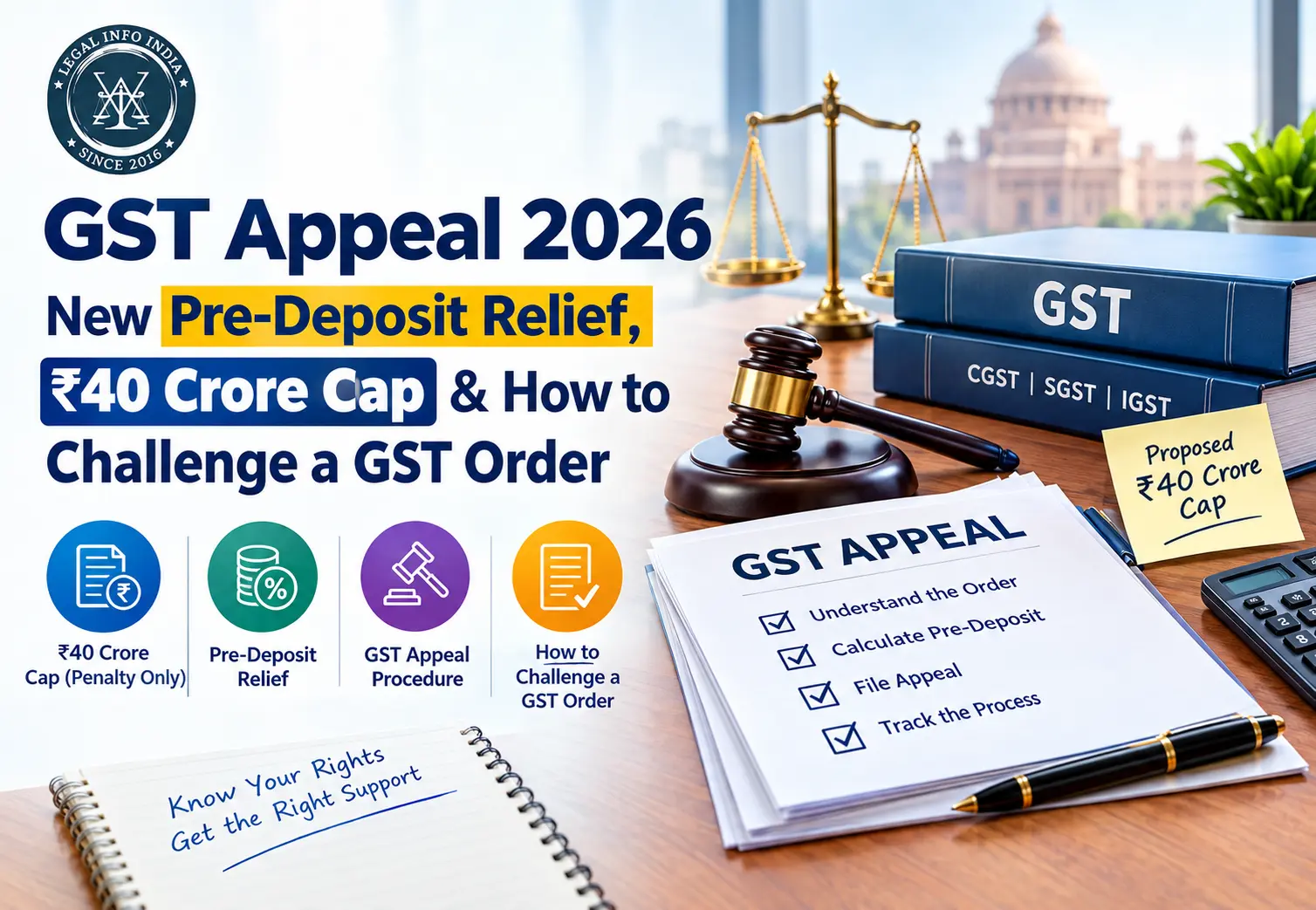
An important development came from the 57th GST Council meeting held on 8 October 2026. The Council recommended an upper limit of ₹40 crore on the pre-deposit for appeals before the Appellate Authority or GST Appellate Tribunal in cases where the order involves a penalty but no demand of tax. The recommendation forms part of wider efforts to simplify GST dispute resolution and reduce unnecessary litigation.
However, there is a critical distinction: the proposed ₹40 crore cap is not a universal limit on every GST appeal. It relates to specified penalty-only cases, and taxpayers must check the relevant statutory amendments and effective dates before relying on it.
In this guide, we explain the GST Appeal 2026 developments, existing appeal procedures, pre-deposit requirements, deadlines, documents and practical steps for challenging an incorrect or disputed GST order.
A pre-deposit is an amount that a taxpayer must pay before pursuing certain statutory appeals against a GST order. It is intended to be paid in accordance with the applicable appeal provisions, rather than being treated as an automatic payment of the entire disputed demand.
Under the existing GST appeal framework, different pre-deposit requirements apply depending on the nature of the order and the appeal stage.
The GST Council has recommended a maximum pre-deposit limit of ₹40 crore for specified appeals involving an order that imposes a penalty without demanding any tax. The recommendation covers appeals before the Appellate Authority and the GST Appellate Tribunal.
Imagine that a company receives a GST order imposing a substantial penalty. The company believes that the penalty is legally unjustified and wants to challenge the order.
If the applicable pre-deposit requirement creates a significant financial burden, the company may face difficulty pursuing the appeal even when it has reasonable grounds to contest the decision.
The proposed cap seeks to address this concern in qualifying penalty-only cases.
Suppose a business receives an order imposing a penalty of ₹500 crore, with no demand of tax.
If the applicable pre-deposit percentage would otherwise produce an amount above ₹40 crore, the proposed cap could limit the required pre-deposit to ₹40 crore, subject to the final legal provisions.
This is an illustrative example, not a calculation of the amount payable in every penalty-only appeal. The actual requirement will depend on the final amendment, the appeal stage and the terms under which the cap is implemented.
No. This is the most important limitation to understand.
The recommendation specifically concerns cases where the order involves a penalty without a demand of tax. It should not be interpreted as a general ₹40 crore ceiling for appeals involving disputed tax, interest and penalty together.
Taxpayers must identify the type of order before determining the relevant pre-deposit requirement.
A GST appeal pre-deposit is a statutory payment required to pursue certain appeals under the Central Goods and Services Tax Act, 2017, and corresponding State or Union Territory GST laws.
The amount depends on the type of order, the disputed amount, the applicable statutory section and the appeal stage.
The pre-deposit mechanism is different from simply paying the full demand raised by the department. It is also different from paying an amount that the taxpayer has already accepted as payable.
Under Section 107(6) of the CGST Act, a first appeal generally requires payment of the amount admitted by the appellant, together with the prescribed percentage of the remaining disputed tax, subject to the statutory conditions and applicable cap. Section 112 contains the requirements for appeals before the GST Appellate Tribunal.
The statutory framework balances two interests:
The taxpayer's right to challenge an order through the appeal process.
The government's interest in ensuring that an appeal is accompanied by the prescribed payment and that the dispute is pursued through the statutory procedure.
For businesses, understanding the pre-deposit requirement early can help prevent delays and avoidable financial pressure.
Not necessarily. A pre-deposit is a payment made to satisfy the statutory condition for pursuing an appeal. A penalty is a liability imposed under the applicable legal provision.
The relationship between the two depends on the nature of the order and the relevant section. A taxpayer should not assume that making a pre-deposit automatically settles the underlying dispute or that the amount will necessarily be refunded.
The proposed ₹40 crore cap must be understood alongside the existing appeal framework.
Section 107 of the CGST Act governs appeals before the Appellate Authority.
Broadly, the appellant must pay the amount admitted as payable and the prescribed pre-deposit on the disputed tax, subject to the conditions and statutory limits in force.
Where the dispute concerns only a penalty and no tax demand, the applicable provisions must be examined separately. The GST Council's proposed relief is specifically relevant to this category of case.
Section 112 governs appeals before the GST Appellate Tribunal.
The statutory framework includes requirements relating to the amount already paid at the first appeal stage and the additional pre-deposit applicable to the Tribunal appeal. It also contains a separate provision for an order demanding penalty without involving a demand of tax.
The exact amount payable should be calculated from the applicable version of the law, taking account of any amendment that has come into force.
Before calculating the pre-deposit, determine whether the order involves:
A demand of tax.
Interest on an alleged tax shortfall.
A penalty without a demand of tax.
A combination of tax, interest and penalty.
Another type of order governed by a separate provision.
The answer affects the applicable appeal route and the amount that may need to be paid before the appeal proceeds.
Practical point: Do not calculate a pre-deposit simply by applying a percentage to the total figure shown in the order. Tax, interest, penalty and other amounts may be treated differently under the applicable provision.
If you believe a GST order is incorrect, you should first understand the findings made by the department and then determine the appropriate legal remedy.
The following steps provide a practical overview.
Identify the following details:
Order number and date.
Date on which the order was communicated.
Relevant tax period.
Statutory section under which the order was issued.
Tax, interest, penalty and other amounts involved.
Findings and reasons recorded by the authority.
Available appeal route and relevant deadline.
The date of communication can be especially important when calculating the time available to appeal.
A taxpayer may have grounds to challenge an order where, for example:
The tax calculation is incorrect.
The department has misunderstood the transaction.
Supporting invoices or records were not properly considered.
The applicable GST provision has been interpreted incorrectly.
The order contains a procedural defect.
The penalty has been imposed without an adequate legal basis.
The conclusion does not properly address the taxpayer's explanation.
These are possible grounds, not automatic reasons for setting aside an order. Each argument must be supported by the relevant facts, records and legal provisions.
Organise the documents relevant to the dispute. Depending on the case, these may include:
The original GST order and show-cause notice.
The reply previously submitted to the department.
GST returns, including relevant GSTR-1 and GSTR-3B filings.
Purchase and sales invoices.
Reconciliation statements.
Input tax credit records.
Payment challans and electronic ledger records.
Contracts, purchase orders or correspondence.
Documents supporting the legal grounds of appeal.
Keep the records arranged in a clear sequence. This makes it easier to connect each ground of appeal with the evidence supporting it.
Under Section 107, an appeal to the Appellate Authority is generally required within three months from the date the relevant decision or order is communicated to the taxpayer. The law provides limited discretion to condone a delay of up to a further one month, subject to the statutory conditions.
For a Tribunal appeal under Section 112, the statutory framework generally refers to three months, but the applicable commencement rules and any relevant notifications must also be checked. The actual deadline should be verified for the particular order and appeal route.
Do not assume that the deadline is always calculated from the date printed on the order. The date of communication and any applicable special provisions may affect the calculation.
Once the appeal route is identified, calculate the amount required under the relevant provision.
Check:
The amount admitted as payable.
The disputed tax, if any.
The applicable pre-deposit percentage.
The statutory maximum or cap.
Any amount already paid at an earlier stage.
Whether the proposed ₹40 crore cap is legally effective and applies to the case.
If the order involves only a penalty and no demand of tax, examine the specific provisions and the status of the Council's recommendation before making the calculation.
The appeal should clearly explain why the order is being challenged.
A well-structured appeal generally identifies the disputed findings, explains the relevant facts, sets out the legal grounds, refers to supporting documents and states the relief requested.
Avoid submitting a generic statement that the order is unfair. Explain exactly what is disputed and why the relevant finding should be reconsidered.
The CGST Rules prescribe forms and procedures for statutory appeals.
Broadly, FORM GST APL-01 is used for an appeal before the Appellate Authority, while FORM GST APL-05 is used for an appeal before the GST Appellate Tribunal. The prescribed filing method, supporting documents, acknowledgement requirements and applicable rules should be checked at the time of filing.
Keep proof of filing, the acknowledgement, payment records and copies of all supporting documents.
After filing, monitor communications from the appellate authority or Tribunal.
Respond to requests for documents, attend hearings where required and keep records of any additional submissions. If a recovery or enforcement issue arises, obtain advice on the remedies available under the applicable law.
Filing an appeal does not mean every procedural requirement disappears. The taxpayer should follow the applicable rules until the matter is decided.
This is an important question for businesses planning an appeal in October 2026.
The GST Council recommends changes to the GST framework, but a recommendation must be implemented through the relevant legislative amendment, notification, rule or other legally required instrument before taxpayers can rely on it as an operative rule.
The government's announcement concerning the 57th GST Council meeting describes the ₹40 crore cap as a recommendation.
Therefore, before claiming the proposed relief, taxpayers should verify:
Whether the relevant amendment has been enacted.
Whether the required notification has been issued.
The commencement date of the amendment.
Whether the provision applies to the specific type of appeal.
Whether any transitional or pending-case provisions apply.
If the amendment has not yet taken effect, the existing applicable pre-deposit provisions continue to be relevant.
Important: Do not delay a time-sensitive appeal while waiting for the proposed cap. Preserve the appeal deadline and assess the current legal requirements with an appropriately qualified professional.
For official updates, consult the GST Council website and the CBIC GST legislation and rules portal. If you have received a notice rather than an order, you may also read our guide to GST Notice Rules 2026.
Not every GST dispute involves a demand for unpaid tax. In some cases, the order may impose a penalty without demanding any tax.
For example, a business might challenge a penalty arising from an alleged procedural contravention. The taxpayer may believe that the facts were misunderstood, the relevant legal provision was applied incorrectly or the penalty lacks an adequate basis.
In such cases, the appeal should focus on the legal and factual grounds for challenging the penalty.
The provision invoked: Identify the statutory section under which the penalty was imposed.
The findings in the order: Determine which conduct or omission the authority has treated as a contravention.
The supporting evidence: Gather records that explain the transaction, filing, documentation or other relevant circumstances.
The proportionality and legality of the penalty: Check the applicable provision and whether the authority has followed the required procedure.
The pre-deposit requirement: Determine whether the order is genuinely penalty-only and whether the proposed ₹40 crore cap has become effective for the relevant appeal.
The Council's recommendation could be significant for qualifying penalty-only cases, particularly where the existing pre-deposit calculation produces a substantial amount. It does not, however, guarantee that a penalty will be cancelled or that an appeal will succeed.
A strong legal argument can be undermined by procedural mistakes. Businesses should pay attention to the following issues.
Missing the appeal deadline — A taxpayer who waits too long may face difficulty getting an appeal admitted. Record the date of communication and calculate the applicable limitation period immediately.
Assuming the ₹40 crore cap applies to every case — The recommendation concerns specified penalty-only cases without a demand of tax. Do not apply it automatically to a combined tax and penalty demand.
Using the total demand to calculate the pre-deposit — The applicable calculation depends on the relevant statutory provision. Tax, interest, penalty and amounts already paid may require separate treatment.
Filing without clear grounds — An appeal should explain the errors alleged in the order and the relief requested. Merely stating that the demand is excessive may not adequately address the legal issues.
Ignoring the pre-deposit requirement — Failure to meet the statutory pre-deposit condition can create problems with the admission or continuation of an appeal. Verify the required amount before filing.
Relying on news reports instead of the effective law — A news report can explain a recommendation, but the applicable statutory provision and official implementation documents determine the legal position.
Failing to preserve supporting records — Invoices, returns, reconciliations, payment proofs and earlier submissions can be essential to demonstrating why an order should be reconsidered.
For startups and small businesses, a GST dispute can create more than a legal problem. It may affect cash flow, working capital, supplier relationships and the ability to plan future expenditure.
A business facing an adverse order should assess the financial and legal consequences together.
For example, a company that receives a substantial penalty-only order may need to consider the cost of the pre-deposit, professional assistance and the time required to pursue the appeal. The proposed ₹40 crore cap could become relevant if the final amendment covers its case.
Businesses can also reduce future disputes by maintaining reliable records, reconciling returns, reviewing input tax credit claims and responding to official communications on time.
Where registration or compliance questions are contributing to recurring problems, reviewing the business's GST processes may help identify gaps. Legal Info India provides information on GST and other business registration services.
For businesses in Delhi, guidance on GST registration and compliance may be useful alongside appropriate professional assistance for a disputed order. The correct approach depends on whether the issue concerns registration, return filing, a demand, a penalty or a statutory appeal.
Businesses with several compliance requirements may also want to read our guides on Company/Startup Registration in Delhi India, Best MSME Registration in Delhi India and Best FSSAI Registration in Delhi India.
A GST order should be evaluated on its facts, supporting documents and applicable law. The right next step may involve correcting a compliance issue, responding to a communication, making a payment or challenging an order through the appropriate remedy.
Legal Info India provides information and assistance relating to business registrations and compliance requirements. Depending on the nature of a matter, a taxpayer may need support understanding the relevant documentation, identifying compliance gaps or locating an appropriately qualified tax or legal professional for an appeal.
When choosing a service provider, look for someone who:
Explains the relevant GST provisions in clear language.
Reviews the order and supporting records.
Identifies the applicable deadline and appeal route.
Explains the pre-deposit calculation and other potential costs.
Clearly describes the scope of professional assistance.
Does not promise guaranteed cancellation of a demand or penalty.
An appeal requires careful analysis. No service provider should guarantee a particular outcome before reviewing the facts and applicable law.
You can visit Legal Info India to explore business registration and compliance services.
For the latest recommendations, amendments and notifications, you may also refer to:
GST Council — press releases and recommendations
Press Information Bureau (PIB) — 57th GST Council meeting recommendations
CBIC GST Portal — CGST Act (Section 112) and GST appeal rules

The GST Appeal 2026 recommendations are important for taxpayers dealing with substantial penalties. The proposed ₹40 crore pre-deposit cap could reduce the financial burden in qualifying cases where an order imposes a penalty without demanding any tax.
However, it is not a universal cap for all GST appeals, and its practical availability depends on the applicable legal implementation.
If you receive an adverse GST order, review it promptly, identify the grounds for challenge, calculate the deadline and pre-deposit, and prepare a properly supported appeal. Waiting too long or relying only on a headline about proposed relief may put your legal position at risk.
For information about GST registration and business compliance, visit Legal Info India.
The GST Council recommended an upper limit of ₹40 crore on the pre-deposit for appeals before the Appellate Authority or GST Appellate Tribunal in specified cases where the order involves a penalty without a demand of tax. The final legal provisions and effective date must be checked before relying on the cap.
No. The recommendation is specifically concerned with penalty-only orders that do not involve a demand of tax. It is not a universal cap for all appeals involving tax, interest and penalty.
The 57th GST Council meeting recommended the cap on 8 October 2026. Taxpayers should verify whether the relevant amendment or notification has been issued and commenced before treating the recommendation as an enforceable rule.
A GST appeal pre-deposit is a statutory payment required for certain appeals under the CGST Act. The amount depends on the applicable section, the nature of the order, the disputed amount and the stage of appeal.
First, review the order and identify the grounds for challenging it. Calculate the applicable deadline and pre-deposit, prepare the supporting documents and grounds of appeal, and file using the prescribed procedure. FORM GST APL-01 is used for an appeal before the Appellate Authority, while FORM GST APL-05 is used for a Tribunal appeal, subject to the applicable rules.
Under Section 107, an appeal to the Appellate Authority is generally filed within three months from communication of the decision or order. A further period of up to one month may be condoned under the statutory conditions. Check the applicable provision and the facts of your case before calculating the deadline.
Yes, a taxpayer may challenge an adverse order through the applicable statutory remedy if there are valid grounds. The relevant section, findings, documents, deadline and pre-deposit requirement should be reviewed. The proposed ₹40 crore cap is relevant only if the case falls within its scope and the provision has taken effect.
The treatment of a pre-deposit depends on the applicable law and the outcome of the proceedings. A taxpayer should review the relevant refund provisions and any applicable interest rules rather than assume that the amount will automatically be refunded in every situation.
The available remedy and payment requirements depend on the applicable statutory provisions and the nature of the dispute. Identify the amount admitted, the amount contested and the relevant findings before preparing the appeal.
Check the GST Council website, the CBIC GST legislation portal and the CBIC appeal rules. Look for the relevant amendment, notification, commencement date and procedural requirements.


We prioritize understanding your unique situation & offer tailored strategies that align with your goals,
don't navigate the legal maze alone – schedule.

Call Us 24/7
+91 9999 860 803
Call Us 24/7
+91 8527 406 788
Mail Us Anytime
info@legalinfoindia.in
Mail Us Anytime
nrandassociate@gmail.com
© Copyright 2025 LegalInfoIndia
Developed By:Vairina Infotech



 16 Oct 2026 (Last updated: 16 Oct 2026)