
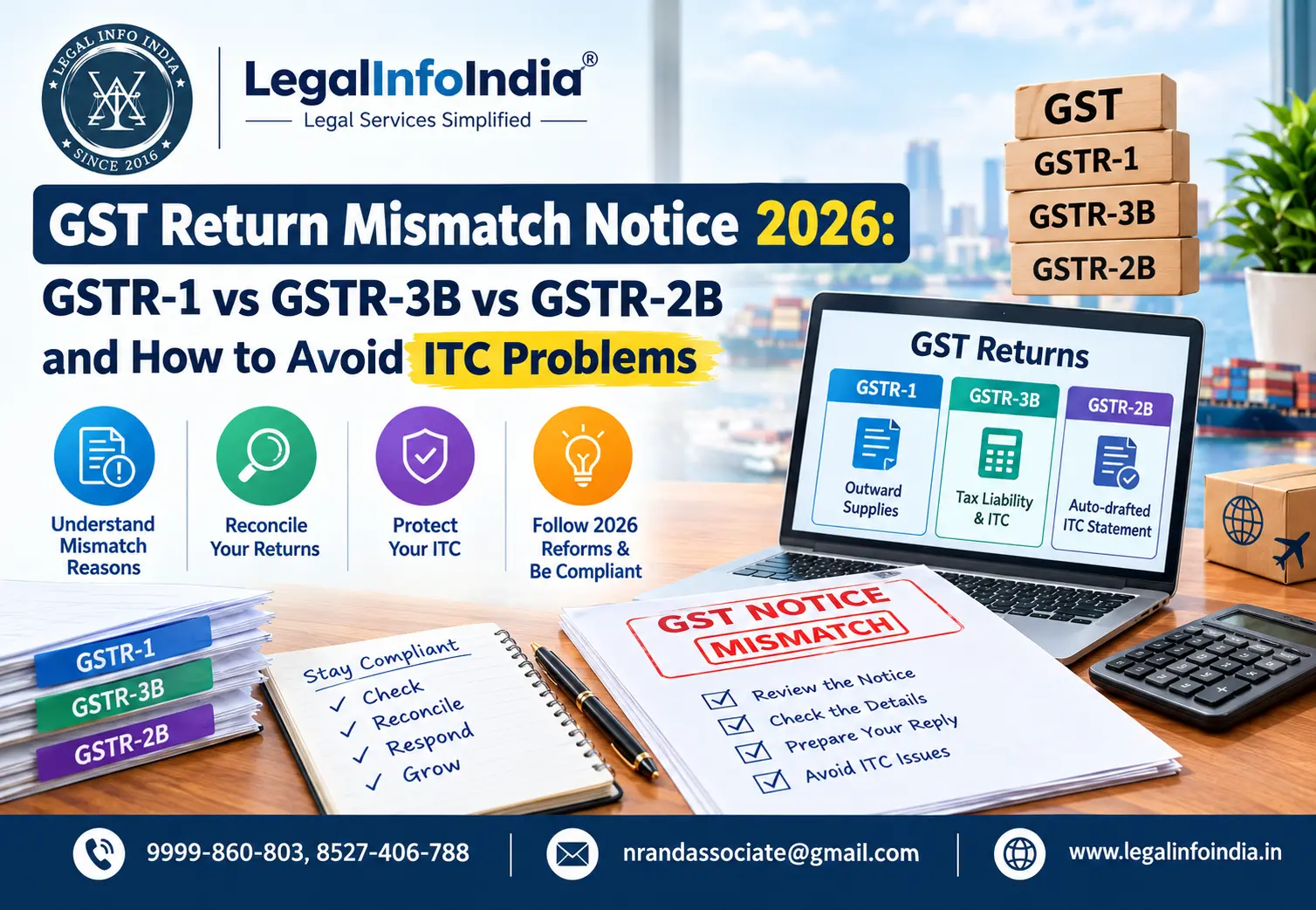

Note: The reforms discussed below are GST Council recommendations from the 57th meeting held on 8 October 2026. They are distinguished throughout from amendments that have legally taken effect. The publication and last-updated dates are shown above, and the article will be revised if notifications, rules or circulars change the position. It is for general information and is not a substitute for advice on an individual notice.
Introduction: Why GST Return Mismatches Matter in 2026
For many Indian businesses, filing GST returns every month or quarter is a routine compliance responsibility. However, even businesses that file returns regularly can face difficulties when their sales figures, tax liability and input tax credit (ITC) do not match across different GST forms.
A business may report sales in GSTR-1 but declare a different tax liability in GSTR-3B. A buyer may claim input tax credit in GSTR-3B that does not match the credit reflected in GSTR-2B. Sometimes, the underlying transaction is genuine, but an incorrect invoice number, a missed entry, a credit note or a supplier's delayed filing creates a discrepancy.
These differences can lead to system-generated intimations, requests for clarification, scrutiny or other GST proceedings, depending on the nature of the mismatch and the applicable law.
The issue has received renewed attention in 2026. At its 57th meeting on 8 October 2026, the GST Council recommended changes to the return filing system to improve reconciliation between outward supplies, tax liability and ITC. The proposed measures include improvements to GSTR-1, GSTR-1A and the Invoice Furnishing Facility (IFF), mechanisms to correct certain mismatches in GSTR-3B, and improvements to ITC reporting.
The Council recommended that the alternate correction mechanism apply from the April 2027 return period, subject to the required implementation steps. These proposals should not be treated as a blanket relaxation of current GST compliance requirements. Businesses must continue to follow the rules applicable to their tax periods. Official GST Council recommendations.
In this guide, we explain the differences between GSTR-1, GSTR-3B and GSTR-2B, common reasons for mismatches, how to protect eligible ITC, what to do after receiving a GST mismatch notice, and how businesses can prepare for the proposed GST return reforms.
A GST return mismatch occurs when information reported in different GST returns, statements, invoices or tax records does not agree.
For example, a business reports taxable sales of ₹10 lakh in GSTR-1 but its corresponding GSTR-3B contains figures that imply a different taxable turnover. Alternatively, a business claims ITC of ₹1 lakh in GSTR-3B, while its GSTR-2B shows only ₹80,000 of potentially available credit for the relevant period.
A mismatch does not automatically prove tax evasion or establish that an ITC claim is invalid. It indicates that the difference needs to be examined and, where necessary, corrected or explained.
Depending on the circumstances, a taxpayer may receive an automated communication, an intimation, a scrutiny notice or a formal demand-related notice. Each document has a different purpose and may require a different response.
Sales mismatch: GSTR-1 and GSTR-3B report different outward supply or tax liability figures.
ITC mismatch: ITC claimed in GSTR-3B differs from the credit reflected in GSTR-2B.
Supplier mismatch: A supplier has not reported an invoice correctly or has not filed the relevant statement.
Period mismatch: An invoice or credit note appears in a different tax period from the one in which the recipient recorded it.
Tax payment mismatch: The declared tax liability, payments made and return disclosures do not reconcile.
Classification mismatch: Differences arise from tax rates, place of supply, taxable or exempt classification, or the treatment of a transaction.
The first step is to identify the exact difference and the period involved. Do not assume that every discrepancy requires the same correction or payment.
Understanding these three forms is essential for preventing ITC problems and responding to GST mismatch notices.
GSTR-1 is the statement in which a registered taxpayer reports details of outward supplies, subject to the applicable filing requirements.
It generally includes information about sales invoices, debit notes, credit notes, exports and other specified outward supply details.
Buyers and the GST system use supplier-reported information as part of the wider process for tracking transactions and determining the availability of ITC.
Example: A Delhi-based company sells goods worth ₹5 lakh to a registered business in Haryana. The seller must report the transaction correctly, including the applicable tax treatment and invoice details, in its outward supply statement.
If the invoice is omitted, entered under an incorrect GSTIN or reported with an incorrect taxable value, it may create a discrepancy for the seller or buyer.
GSTR-3B is a summary return used by taxpayers to declare relevant outward supply figures, tax liabilities, eligible ITC and other prescribed details for a tax period.
It is also used to discharge the tax liability in accordance with the applicable GST rules.
The figures reported in GSTR-3B should be supported by the taxpayer's books, sales records, purchase records and reconciliation working papers.
Example: If a business reports taxable sales in GSTR-1 but omits part of the corresponding liability from GSTR-3B, the difference may require reconciliation and correction under the applicable procedure.
A difference may also arise because of timing, amendments or other legitimate reasons. The taxpayer should identify the cause instead of making an unsupported adjustment.
GSTR-2B is an auto-drafted statement that provides information relevant to a taxpayer's input tax credit. It is generated using information reported through the GST system, including details furnished by suppliers.
It helps recipients review invoices, debit notes, credit notes and other documents relevant to ITC.
However, the appearance of an invoice in GSTR-2B should not be treated as the only condition for claiming credit. The taxpayer must also satisfy the applicable legal requirements for ITC, including relevant conditions under Section 16 of the CGST Act and restrictions under Section 17.
Example: A company purchases raw materials worth ₹2 lakh plus GST. The supplier's invoice is genuine, but the supplier has not reported it correctly. The recipient may not see the expected credit in GSTR-2B for that period.
The recipient should verify the invoice, contact the supplier and review the applicable ITC rules before deciding what action to take.
| GST form | Main purpose | What should be reconciled? |
|---|---|---|
| GSTR-1 | Reports outward supplies | Sales invoices, taxable value, tax rates, amendments and credit notes |
| GSTR-3B | Summarises liability and ITC, and supports tax payment | Taxable turnover, tax payable, eligible ITC, reversals and tax paid |
| GSTR-2B | Provides an auto-drafted ITC statement | Supplier-reported documents and credit relevant to the recipient |
The key principle is simple: GSTR-1, GSTR-3B, GSTR-2B and the underlying books should tell a consistent, explainable story.
A mismatch between GSTR-1 and GSTR-3B can arise for several reasons. Some are genuine reporting errors, while others relate to adjustments or timing.
An invoice may be recorded in the accounting software but omitted from GSTR-1. Alternatively, it may be reported in GSTR-1 but not correctly included in the summary figures in GSTR-3B.
Prevention: Reconcile the sales register with GSTR-1 and GSTR-3B before filing.
A wrong tax rate, taxable value or tax calculation can cause the figures to differ.
For example, an invoice may be entered as ₹1,00,000 in the books but reported as ₹90,000 in the return because of an entry error.
Prevention: Use a standard invoice format, correct tax codes and an appropriate review process.
Credit notes may reduce the value of a supply, while debit notes may increase it. If these documents are recorded in one system but omitted or treated differently in another, a mismatch can arise.
Prevention: Reconcile all amendments, credit notes and debit notes for the relevant period.
A taxpayer may correct an earlier invoice in a subsequent period using an available and legally permitted mechanism. If the amendment is not properly tracked, reports for different periods may appear inconsistent.
Prevention: Maintain an amendment register showing the original invoice, the correction, the relevant tax period and the impact on liability.
Errors can occur when tax rates, place of supply, reverse charge or other transaction details are misunderstood.
Prevention: Review the tax treatment of unusual transactions before filing. Obtain professional advice where the applicable GST provision is unclear.
GSTR-2B mismatches are a common concern because an incorrect or unsupported ITC claim can create a tax exposure.
The following are common causes.
A supplier may have issued an invoice but failed to report it correctly in the relevant statement. The recipient may therefore not see the expected credit in GSTR-2B.
What to do: Contact the supplier, share the invoice details and request that the supplier verify its filing and make any correction permitted by law.
Do not assume that an invoice alone guarantees eligibility for ITC.
If a supplier enters the buyer's GSTIN incorrectly, the invoice may not appear against the intended recipient's records.
What to do: Verify the GSTIN on the invoice and ask the supplier to correct the error through the legally available process.
A supplier may report an invoice in a later period, or the recipient may record it in the wrong accounting period.
What to do: Compare the purchase register across periods and track the invoice until its reporting position is understood.
A business may claim credit because GST appears on a purchase invoice, even though the credit is restricted, the statutory conditions are not satisfied, or the purchase is unrelated to eligible business activities.
What to do: Check both documentary support and the applicable eligibility conditions before claiming credit.
Credit notes, purchase returns, supplier adjustments and other events may affect the credit available to a recipient. Failure to record the corresponding adjustment can create differences.
What to do: Maintain a credit-note and ITC-reversal register. Reconcile reversals and any eligible reclaim with the relevant supporting records and applicable rules.
Certain supplies may be subject to reverse charge, where the recipient is responsible for paying GST under the applicable provisions. Errors can arise when liability and any related ITC are reported in the wrong place or period.
What to do: Review reverse-charge transactions separately, including tax payment and the conditions for claiming any corresponding ITC.
A monthly reconciliation process can identify errors before they turn into more complicated compliance issues.
The exact reconciliation method depends on the business, its accounting system and the relevant GST requirements. The following workflow provides a practical starting point.
Compare the accounting sales register with the outward supply statement.
Check:
Invoice numbers and dates.
Customer GSTINs.
Taxable values and tax amounts.
Applicable tax rates.
Credit notes and debit notes.
Exports, exempt supplies and other relevant categories.
Amendments to earlier invoices.
Record each difference and determine whether it is an accounting error, a reporting error or a legitimate timing difference.
Compare the relevant outward supply and tax liability figures.
Differences may arise because of amendments, adjustments or different reporting treatments. Each difference should be explained in a reconciliation statement.
Do not simply change one figure to force a match. First establish which figure is correct and what correction is legally available.
Compare purchase records with the auto-drafted ITC statement.
Use invoice-level matching wherever possible. At a minimum, verify the supplier GSTIN, invoice number, date, taxable value, tax amount and credit-note information.
Classify unmatched entries into categories such as:
Invoice not appearing in GSTR-2B.
Incorrect GSTIN or invoice details.
Invoice reported in a different period.
Credit note or purchase return.
Potentially ineligible ITC.
Duplicate entry.
Other differences requiring investigation.
Before claiming or reclaiming credit, check the statutory conditions and restrictions.
These can include possession of prescribed documents, receipt of goods or services, supplier reporting and tax-payment-related conditions, filing requirements and blocked-credit restrictions, as applicable to the transaction and tax period.
Where credit is ineligible, determine the appropriate reversal or non-claim treatment under the applicable law.
Maintain a record of ITC claimed in GSTR-3B, credit reversed, the reason for reversal and any later reclaim.
A reclaim should not be made merely because an earlier mismatch has disappeared. Confirm that the legal conditions for reclaim are satisfied and retain the supporting evidence.
Prepare a reconciliation sheet showing:
The amount reported in each relevant record.
The difference.
The reason for the difference.
The action taken or proposed.
The relevant invoice, credit note or other evidence.
The tax period and correction reference, where applicable.
A clear working paper can help explain the discrepancy if a notice or query arises.
The GST Council's 57th meeting on 8 October 2026 recommended a series of measures to improve return accuracy and reduce avoidable mismatch-related communications.
These proposals are relevant to businesses, accountants and tax professionals because they focus on the connection between sales reporting, tax payment and ITC claims.
The Council recommended enhancements to these forms and facilities so that the information furnished can be reconciled more effectively with GSTR-3B.
GSTR-1A provides a mechanism for adding or amending certain outward supply details after filing GSTR-1, subject to the applicable rules and timelines. IFF is an optional facility available to eligible taxpayers under the QRMP scheme for furnishing specified outward supply details during the first two months of a quarter.
The recommended changes aim to improve consistency between outward supply information and the tax liability declared in GSTR-3B.
The Council recommended a mechanism to report or correct liability in GSTR-3B so that it aligns with details furnished in GSTR-1, GSTR-1A or IFF.
The aim is to address situations where the reporting mechanism creates differences between declared supplies and tax liability.
The Council also recommended a mechanism for correcting ITC reported in GSTR-3B to align it with ITC available in GSTR-2B.
Other proposals include changes to the Invoice Management System, an electronic statement concerning ITC reversal and reclaim, and a statement for tax paid under reverse charge and ITC claimed.
The Council further recommended changes to GST DRC-03 so that the underlying invoice details associated with a payment can be declared.
The Council recommended that the alternate mechanism for correcting liability and ITC apply from the April 2027 return period, subject to the required implementation steps.
The revised forms and proposed procedures were also expected to be placed in the public domain for time-bound consultation. Businesses should monitor official notifications, circulars and GST portal updates before relying on a new correction facility.
Until the relevant changes become legally effective, taxpayers should follow the current provisions and return procedures applicable to their tax periods.
Official reference: Recommendations of the 57th GST Council meeting.
Receiving a GST notice can be stressful, especially for a small business with limited accounting resources. The best response is to understand the communication first and then prepare a fact-based explanation.
Read the document carefully.
Determine whether it is an automated intimation, a request for information, a scrutiny-related communication, a show-cause notice or another formal proceeding.
Check the issuing authority, financial year, tax period, statutory provision, response deadline and the exact discrepancy alleged.
Do not treat every system-generated message as a final demand, but do not ignore it either.
Identify the figures compared by the department.
For example, the communication may allege that:
Tax liability reported in GSTR-1 exceeds liability declared in GSTR-3B.
ITC claimed in GSTR-3B exceeds the amount considered available.
Tax paid does not reconcile with the reported liability.
A particular invoice or transaction appears to have been reported incorrectly.
Prepare a working paper showing the exact difference and how it arose.
Depending on the issue, relevant documents may include:
Sales and purchase registers.
Tax invoices and debit or credit notes.
Filed GSTR-1, GSTR-3B and GSTR-2B records.
Electronic liability and credit ledger extracts.
Payment challans and relevant DRC-03 records.
Supplier correspondence.
Bank or payment records, where relevant.
Reconciliation statements and accounting entries.
Use documents that directly support the explanation. A large bundle of unrelated records can make the response harder to assess.
Not every mismatch is corrected in the same way.
If the discrepancy results from a genuine reporting error, determine the correction mechanism permitted under the applicable law. If the figures are correct but the department's comparison does not account for a relevant adjustment or timing difference, prepare an evidence-based explanation.
If tax, interest or another amount is legally payable, evaluate the appropriate payment and reporting process. Do not make a payment or claim a credit without understanding the underlying issue.
Follow the instructions in the notice and use the prescribed portal or filing method where applicable.
Keep the acknowledgement, submission reference and a copy of the complete response.
If additional time is needed, consider whether an extension is legally available and request it through the appropriate process before the deadline, where possible.
If the notice involves substantial ITC, multiple tax periods, allegations of suppression, disputed tax treatment or a proposed demand, consider consulting a qualified GST professional or tax lawyer.
A response should address the specific allegations and applicable law. Generic explanations or unsupported assertions may not resolve the issue. For the wider legal framework, see our guides on GST Notice Rules 2026 and GST Appeal 2026.
Prevention is usually easier than correcting multiple return periods after a notice arrives.
Set a fixed schedule for reviewing sales, purchases, GSTR-1, GSTR-3B and GSTR-2B. Do not wait until the return due date to identify missing invoices.
If different employees manage sales invoices, purchase entries and return filing, establish a clear handover process.
The person filing returns should receive complete, reviewed accounting data and a list of unresolved discrepancies.
Where an eligible purchase invoice does not appear correctly in GSTR-2B, contact the supplier promptly.
Keep records of the communication and track whether the supplier has made the required correction. Supplier follow-up is useful, but it does not replace the recipient's responsibility to satisfy ITC conditions.
Credit notes, purchase returns, blocked credits and other reversal situations should be tracked separately.
Maintain a record of the original credit, the reversal or adjustment, the reason and any eligible reclaim.
Do not change GSTR-3B figures simply to make them agree with another return.
Identify the underlying reason, verify the correct amount and use the mechanism permitted for the relevant period.
Keep return acknowledgements, invoices, reconciliation statements, payment proofs and material supplier correspondence organised by tax period.
A well-maintained record helps with internal review and any future notice.
Exports, reverse-charge supplies, credit notes, high-value transactions, amendments and changes in tax classification can require additional attention.
Review these transactions separately instead of relying only on a broad total-level comparison.
Ignoring the notice: A mismatch should be investigated even when the business believes the transaction is genuine.
Assuming every GSTR-2B difference is harmless: The reason for the difference must be established and the applicable ITC conditions must be checked.
Claiming ITC based only on an invoice: An invoice is important evidence, but all applicable statutory conditions and restrictions must be satisfied.
Paying the disputed amount without reconciliation: First understand the legal basis, amount and consequences. Where payment is necessary, follow the prescribed procedure.
Using the wrong correction method: The correct route depends on the tax period, form, nature of the error and current legal provisions.
Missing the response deadline: Record the due date immediately and retain proof of submission.
Assuming the 2027 reforms apply today: The proposed mechanism should not be treated as available before the relevant provisions take effect.
Sending a generic reply: Address each allegation separately and support the explanation with relevant records.
GST return reconciliation is not only about matching figures. It also involves understanding why a difference occurred, checking whether the ITC is eligible, identifying the proper correction mechanism and responding to official communications within the required time.
Legal Info India helps businesses explore registration and business compliance services, including GST registration, company registration and MSME registration assistance.
If your business is preparing to register, expanding operations or reviewing its compliance requirements, our team can help you identify the relevant registration-related steps and documentation needs.
Explore our GST and business registration services or visit Legal Info India.
For a notice involving disputed ITC, tax demand, interest, penalties or formal proceedings, seek advice from a suitably qualified GST professional or tax lawyer who can review the actual notice and supporting records.
Press Information Bureau: Recommendations of the 57th Meeting of the GST Council
GST Council: Official press releases
GST Portal: Returns, services and taxpayer facilities
CBIC GST: GST laws, rules and notifications
CBIC Tax Information Portal: Central GST Act and related provisions

GST return mismatches can create avoidable compliance difficulties, but a systematic reconciliation process can help businesses identify errors early and explain genuine differences.
GSTR-1, GSTR-3B and GSTR-2B serve different purposes. Businesses should understand these differences, verify the underlying transactions and ensure that reported tax liability and ITC are supported by proper records and the applicable law.
The GST Council's October 2026 recommendations indicate a move towards better return alignment and more structured correction mechanisms, with the proposed alternate mechanism intended for the April 2027 return period. Until the relevant provisions take effect, taxpayers should continue to comply with the rules currently applicable to their tax periods.
If you receive a GST return mismatch notice, do not ignore it or assume that the discrepancy is automatically a tax demand. Identify the issue, collect the evidence, check the applicable procedure and submit an appropriate response within the prescribed time.
Need assistance with business registration or compliance preparation? Visit Legal Info India to explore our services.
It is a communication concerning a difference between GST returns, statements, invoices or tax records. Depending on the circumstances, it may be an intimation, a request for information, a scrutiny communication or a formal notice. The appropriate response depends on the document and the discrepancy.
GSTR-1 reports details of outward supplies, while GSTR-3B is a summary return used to declare relevant tax liability and ITC and discharge tax. Their figures should reconcile, taking into account legitimate adjustments and the applicable reporting rules.
Possible reasons include supplier non-filing, incorrect GSTIN or invoice details, timing differences, credit notes, duplicate entries, ineligible credit or incorrect reversal and reclaim reporting. Investigate the individual invoices before deciding on a correction.
Do not claim credit merely because you possess an invoice. Check the applicable statutory conditions, supplier reporting requirements, restrictions and the rules for the relevant tax period. If the invoice is missing, investigate the reason and obtain appropriate professional advice where necessary.
Verify the invoice details and contact the supplier to request the necessary reporting or correction. Maintain the communication and track the invoice across tax periods. Separately confirm whether and when the ITC can legally be claimed.
Read the notice, identify the relevant tax period and figures, prepare a reconciliation, collect supporting documents and determine whether correction or explanation is appropriate. Submit a fact-based response using the prescribed process within the deadline.
No. A discrepancy does not automatically establish a violation or make a penalty payable. The consequences depend on the facts, the applicable statutory provisions, whether tax or credit was incorrectly reported, and how the matter is resolved.
The GST Council recommended enhancements to GSTR-1, GSTR-1A and IFF, mechanisms to correct certain liability and ITC mismatches in GSTR-3B, improvements to the Invoice Management System, and related reporting changes. The proposed alternate correction mechanism is intended for the April 2027 return period, subject to implementation.
The available correction method depends on the type of error, the tax period and the applicable GST provisions. Some errors may be addressed through permitted amendments or adjustments in a subsequent period, while other situations require a different procedure. Check the current rules before making a correction.
Reconcile sales and purchase registers with GSTR-1, GSTR-3B and GSTR-2B before filing. Verify invoices and GSTINs, track credit notes and reversals, follow up with suppliers, document differences and respond promptly to official communications.


We prioritize understanding your unique situation & offer tailored strategies that align with your goals,
don't navigate the legal maze alone – schedule.

Call Us 24/7
+91 9999 860 803
Call Us 24/7
+91 8527 406 788
Mail Us Anytime
info@legalinfoindia.in
Mail Us Anytime
nrandassociate@gmail.com
© Copyright 2025 LegalInfoIndia
Developed By:Vairina Infotech



 22 Oct 2026 (Last updated: 22 Oct 2026)